
Introduction: The Hidden Risk Behind AI Content Speed#
The promise of AI content tools is irresistible: publish more, spend less, and rank faster. And the adoption numbers prove it — between 55% and 85% of marketing teams now use AI in some capacity to produce content. But here is the uncomfortable reality hiding behind those headline stats: an estimated 30% to 50% of those same teams have no governance framework in place whatsoever. That means the majority of businesses racing to adopt ai content governance small business practices are essentially flying blind — generating content at speed without the guardrails that keep it accurate, on-brand, and trustworthy.
For small businesses, this gap is especially dangerous. A two-person marketing team that adopts an AI content tool without any structure tends to experience the same predictable pattern: early excitement, a flood of output, and then a slow erosion of brand consistency as different prompts, different tools, and different reviewers produce wildly inconsistent copy. The result is rework, wasted AI credits, and — worst of all — customer-facing content that quietly undermines the brand equity you have spent years building.
Here is the thesis of this guide: a lightweight AI content governance framework for small businesses is not bureaucratic overhead — it is the multiplier that makes AI content automation actually pay off. According to the Content Marketing Institute, brands with documented content strategies are 414% more likely to report success than those without one. Governance is what separates teams that get a short-term productivity spike from teams that build a compounding content engine.
In the sections ahead, you will learn exactly why governance is the most overlooked priority in 2026, how to build a practical 5-step framework tailored for small businesses, how to embed brand voice directly into your AI prompts, how to measure ROI within 90 days, and which common mistakes to avoid along the way.
Why AI Content Governance for Small Businesses Is the #1 Overlooked Priority in 2026#
Let us start with the number that should give every small business owner pause: between 30% and 50% of teams that adopt AI content tools do so without any governance policy in place. Yet research consistently shows that teams with even lightweight guidelines reduce rework rates by 10% to 25%. That gap — between what most teams do and what actually works — is where brand consistency goes to die.
What "Governance" Actually Means for a Small Team#
The word "governance" tends to trigger images of enterprise compliance departments and legal sign-off chains. For a two-to-five person marketing team, it means something far simpler: a living operating manual that tells your AI tools, your team, and your review process how content should look, sound, and behave. It is not a legal document. It is a set of practical rules — documented in plain language — that anyone on your team (or any AI tool you use) can reference before producing a single sentence.
Think of it as the difference between handing a new hire a brand guide on their first day versus letting them figure out your tone of voice by reading old blog posts. One approach produces consistent output from day one. The other produces six weeks of corrections.
The Real Cost of No Governance#
The costs of skipping governance are rarely dramatic — they are insidious. They show up as:
Brand drift: Your blog sounds professional, your email sequences sound casual, and your social captions sound like a different company entirely.
Inconsistent tone across channels: Customers who move from your website to your email list to your Instagram feel like they are interacting with three different brands.
Compliance exposure: AI tools can generate content that inadvertently makes unsubstantiated claims, uses copyrighted phrasing, or violates advertising standards — with no audit trail to catch it.
Wasted AI credits: Without structured prompts and a review tier system, a significant percentage of AI output gets scrapped entirely — negating the time savings that justified the tool purchase in the first place.
As HubSpot's research confirms, teams with documented brand guidelines consistently produce higher-quality output with fewer revisions. As one VP noted: "Governance is not optional; it is the difference between brand drift and brand consistency." That framing is exactly right. Governance is not the thing that slows AI content down — it is the thing that makes AI content worth publishing.
The Compounding Return on Governance Investment#
Here is the counterintuitive math: teams that invest just three to five hours upfront in building a governance framework see compounding returns as AI output volume scales. The more content you produce, the more valuable your Brand Voice Card, your prompt library, and your review tiers become — because they eliminate the per-asset decision-making that eats time at scale. Content automation tools become dramatically more effective when they operate within a governed system rather than in an ad hoc one.
The 5-Step AI Content Governance Framework for Small Businesses in 2026#
This is not theory. The following framework is a sequential, actionable checklist that any small business can implement in a single afternoon. Think of it as your small business content strategy operating system for AI.
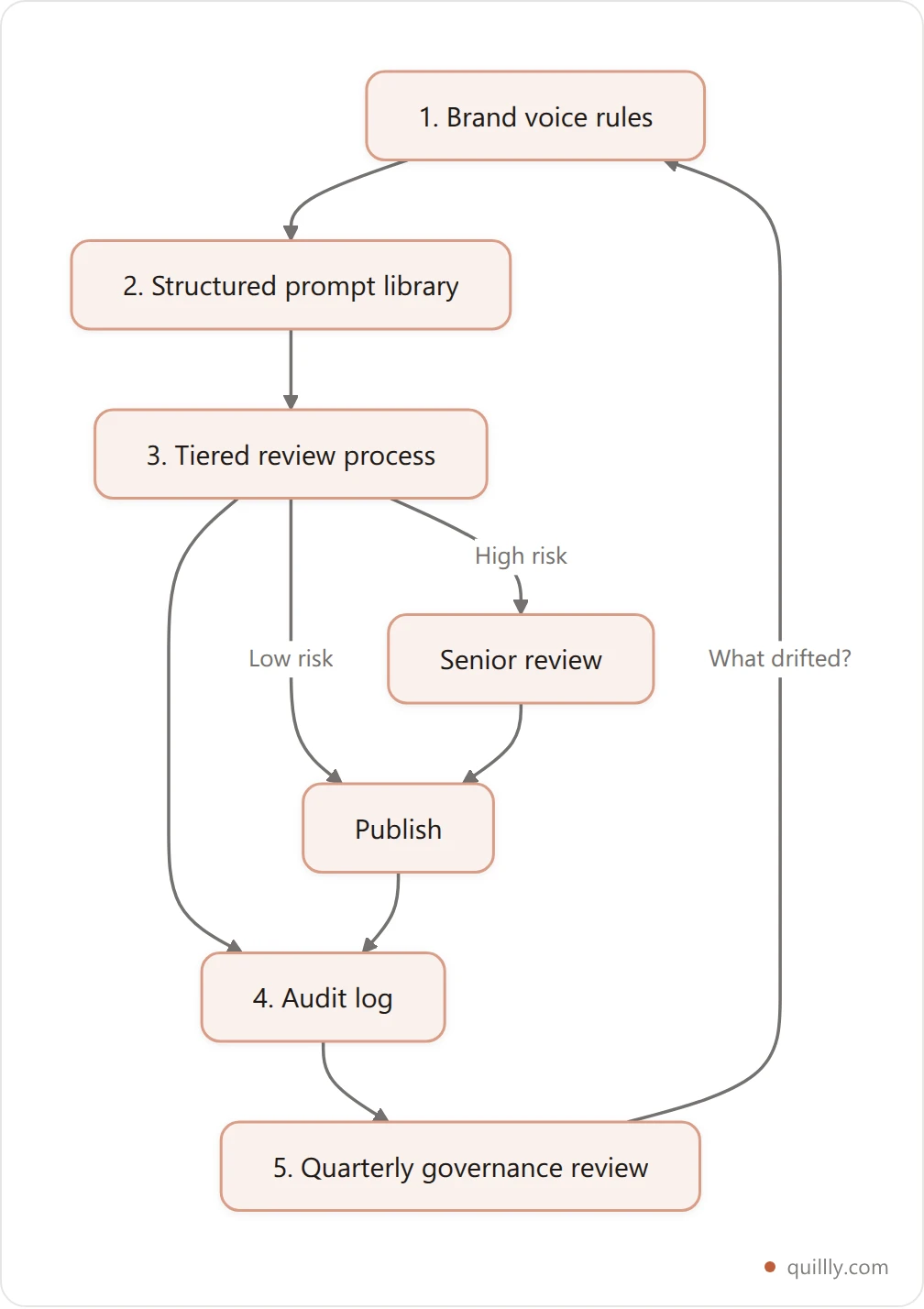
Step 1 — Define Your Brand Voice Rules#
Before you write a single AI prompt, you need a Brand Voice Card — a one-page document that captures:
Tone descriptors: (e.g., "warm but authoritative," "direct but never aggressive")
Vocabulary rules: Words and phrases you always use, and words you never use
Persona definition: Who is speaking? A founder? A category expert? A friendly advisor?
Off-limits content: Topics, claims, or framing that are categorically out of bounds
This document becomes a system instruction that you embed into every AI prompt. When brand voice lives at the prompt level, every output is pre-constrained before a human even reads it. This is the single highest-leverage governance tactic available to small businesses.
Step 2 — Build a Structured Prompt Library#
A prompt library is a shared collection of pre-built, tested prompts organized by content type and funnel stage. Teams using structured briefs and prompt libraries cut production time by 20% to 45% compared to teams writing prompts from scratch each time.
Organize your library by:
Content type: Blog posts, email sequences, ad copy, social captions, landing pages
Funnel stage: Awareness, consideration, decision
Tone variant: Educational, promotional, conversational
Store it in a shared Google Doc or Notion database so every team member — and every AI session — pulls from the same source of truth. Tag each prompt with the date it was last tested and updated.
Step 3 — Establish a Tiered Review Process#
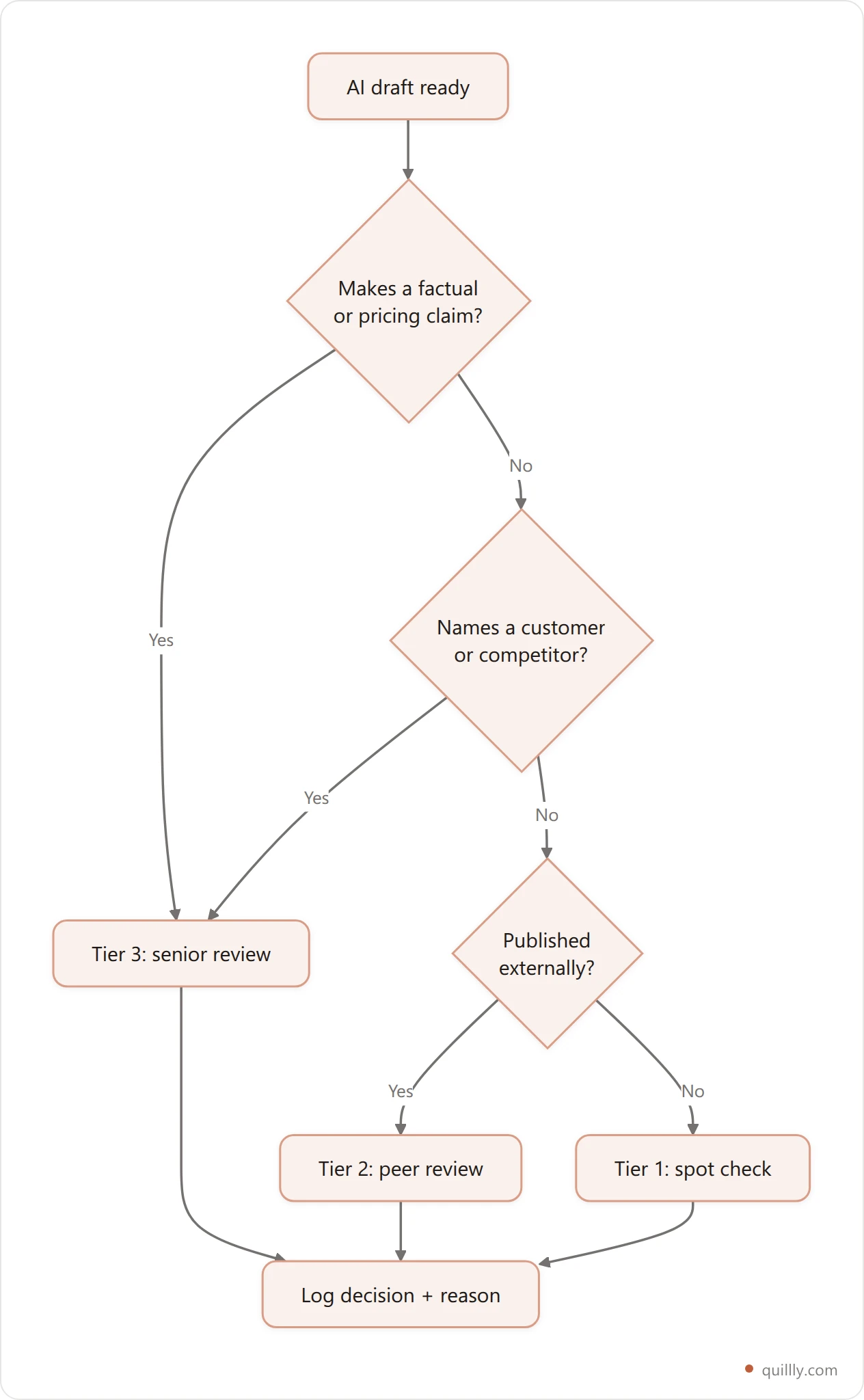
Not every AI output needs the same level of human review. A tiered system protects quality without killing speed:
Tier 1 (High-stakes): Landing pages, press releases, investor communications → Full human edit required
Tier 2 (Medium-stakes): Blog posts, email sequences, product descriptions → Light edit plus brand-voice checklist review
Tier 3 (Low-stakes): Social captions, subject-line variants, short ad copy → Automated grammar check plus publish
This structure ensures your team's editorial attention is allocated where it matters most, while keeping automated content planning workflows fast and lean for lower-risk assets.
Step 4 — Create an Audit Log#
An audit log is your quality control memory. For every AI-generated asset, record:
Date produced
Tool and model version used
Prompt version number
Reviewer name
Publish status and performance notes
A simple spreadsheet is sufficient. The audit log enables you to diagnose quality drift over time, identify which prompt versions produce your best-performing content, and roll back to earlier prompt versions when output quality degrades after a model update.
Step 5 — Set a Quarterly Governance Review Cadence#
AI models update frequently. Brand positioning evolves. Audience expectations shift. Schedule a 60-minute quarterly review to:
Refresh your prompt library based on audit log data
Update your Brand Voice Card to reflect any positioning changes
Assess rework rates and adjust tier assignments accordingly
Align your governance review with your 30-to-90-day ROI measurement window
Governance Starter Kit — 3 documents every SMB needs: Brand Voice Card, Prompt Library, Audit Log Template. These three documents are the entire foundation of a functional AI content governance system for small businesses.
Embedding Brand Voice Directly Into AI Prompts: A Practical Guide#
If there is one tactic in this entire guide that delivers the highest return for the least effort, it is this: embed your brand voice directly into every AI prompt as a system instruction. When brand voice lives inside the prompt, every output is pre-constrained before a human even reads it — dramatically reducing the rework that accounts for the majority of wasted time in ungoverned AI content workflows.
How to Write a Brand-Voice System Prompt#
Consider the difference between these two prompts:
Generic prompt: "Write a 500-word blog introduction about skincare routines for dry skin."
Brand-voice-embedded prompt: "You are a knowledgeable but approachable skincare advisor writing for women aged 28–45 who are skeptical of overcomplicated routines. Tone: warm, direct, science-informed but never clinical. Never use the words 'revolutionary,' 'game-changer,' or 'luxury.' Always lead with a relatable problem before offering a solution. Write a 500-word blog introduction about skincare routines for dry skin. End with a soft transition to product recommendations."
The second prompt produces output that is pre-aligned with brand voice, audience context, and content objective — reducing the editing burden from a full rewrite to a light polish.
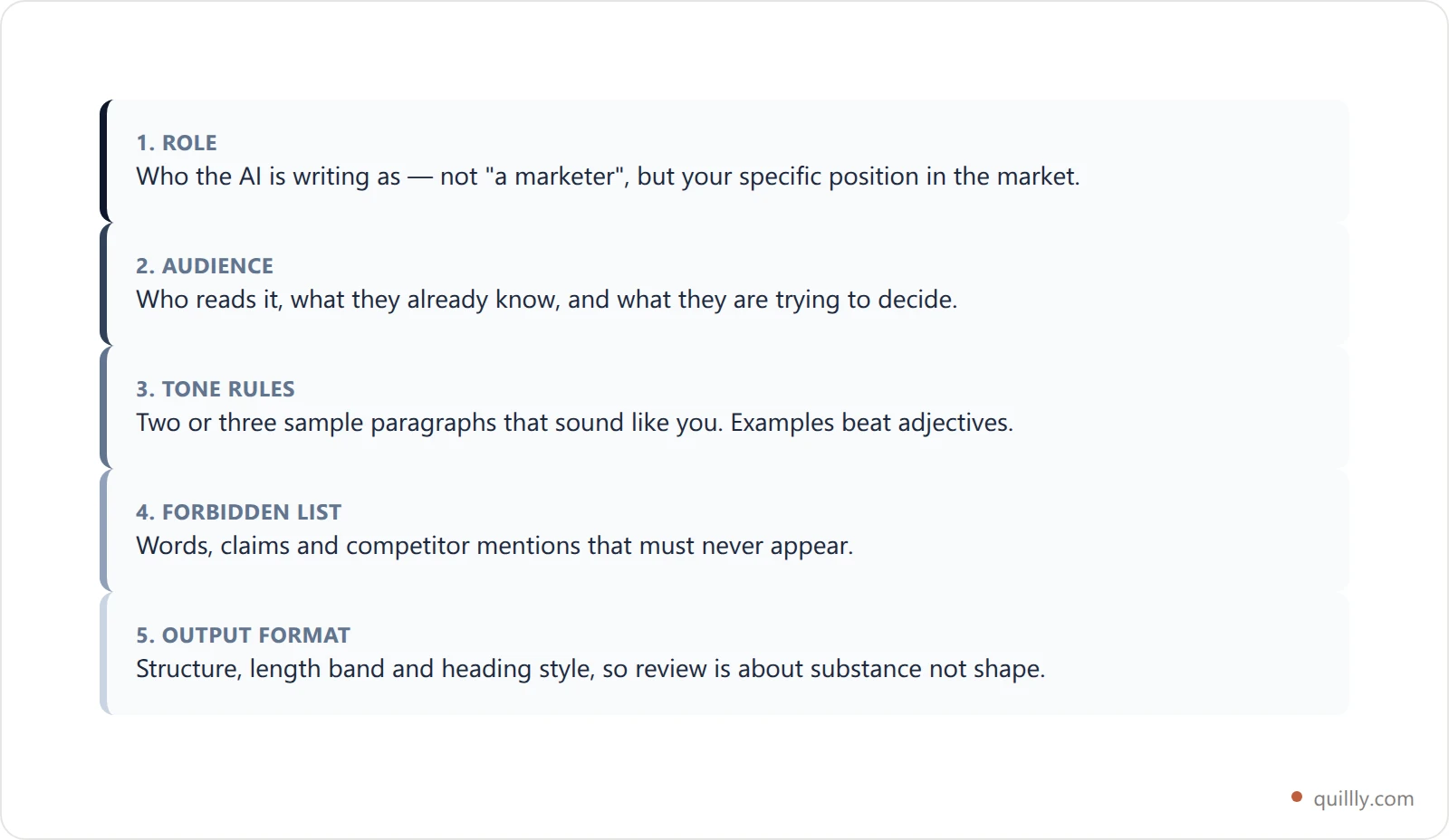
Prompt Anatomy Breakdown#
Every high-performing governed prompt contains these elements:
Role instruction: Who is the AI playing? (e.g., "You are a B2B SaaS content strategist")
Audience definition: Who is reading this? (demographics, psychographics, pain points)
Tone guardrails: What does the voice sound like? What does it never sound like?
Content objective: What should the reader think, feel, or do after reading?
Format specification: Word count, heading structure, paragraph length
Brand voice sample: A single sentence or short paragraph that demonstrates the target voice
Output constraints: Forbidden words, required disclaimers, citation style
For a local e-commerce skincare brand, a master brand-voice block built around these seven elements can be prepended to blog prompts, email prompts, and ad copy prompts without rewriting from scratch — enabling the 20% to 45% production time savings that structured prompt libraries consistently deliver.
Scaling Prompts Across Content Types#
Once your master brand-voice block is built, scaling across content types is a matter of swapping the content objective and format specification while keeping everything else constant. This modular approach is exactly what Jonas Becker of CopyMonkey describes when he notes that "repurposing long-form content into micro-assets is the fastest way to scale content output." A single governed prompt library enables repurposing at two to five times the speed of ungoverned workflows. For a deeper look at multi-channel repurposing workflows, see our guide on AI content repurposing for small businesses.
Bias-Check Layer#
Before publishing any AI-generated content, run a quick five-question bias check — a practice advocated by researchers studying AI output quality:
Does this content use gendered language where neutral language would serve better?
Does it make cultural assumptions that exclude segments of your audience?
Is the vocabulary accessible to readers across education levels?
Does it unintentionally favor or stereotype any demographic group?
Are any claims made that require verification before publishing?
As Dr. Maya Patel of OpenAI has observed: "Small teams often overlook bias; a single mis-step can erode trust." A five-question checklist takes under three minutes and can prevent the kind of public misstep that takes months to repair. For strategies on maintaining brand voice while scaling, see our deep-dive on human-in-the-loop AI content creation.
Measuring the ROI of AI Content Governance: What to Track and When#
Governance is an investment. Like any investment, it needs a return metric — and the good news is that the payback window for well-governed AI content workflows is measurable within 90 days.
The 30–90 Day Payback Window#
Basic AI content tooling pays back in 30 to 90 days when it replaces freelancer hours or reduces agency spend. Governance accelerates this payback by reducing the rework that eats into time savings. The three core metrics to track from day one:
Hours saved per asset: Compare time-to-publish before and after AI adoption
Cost per asset: Factor in tool subscription costs against hours saved
Rework rate: What percentage of AI outputs require major edits before publishing?
Without governance, rework rates typically run between 30% and 50%. With a functioning governance framework, that figure drops to below 15% — a reduction that directly translates to cost savings and faster publishing cycles.

Key Metrics Dashboard for SMBs#
Build a simple one-page dashboard tracking these five metrics:
Metric | Pre-Governance Baseline | Governed Target |
|---|---|---|
Time-to-publish per content type | Baseline | 30%–60% reduction |
Rework rate | 30%–50% | Below 15% |
Cost per asset | Baseline | 10%–30% reduction |
Content volume output | Baseline | 2x–5x increase (repurposed assets) |
Conversion lift on AI content | Baseline | 5%–20% improvement |
Email and Lifecycle ROI Signals#
For small businesses running email marketing, the ROI signals are particularly clear. AI-generated subject-line variants deliver measurable lift, and AI-assisted email flows add meaningful improvement on clicks and conversions. Governed prompts that embed audience segmentation context push toward the higher end of these performance ranges — because the AI is working with more precise instructions rather than generic ones. As Lena Kim, VP at Phrasee, has noted: "The biggest ROI comes from automating email subject lines and CTA copy." Governed subject-line prompts with brand voice constraints consistently outperform generic AI subject lines because they are pre-aligned with audience expectations and brand tone.
How to Run a 90-Day Governance Pilot#
Weeks 1–2: Set up Brand Voice Card and Prompt Library; assign tier classifications to your top five content types
Weeks 3–4: Run your first governed AI content batch across three content types; log every asset in your audit log
Weeks 5–8: Collect rework rate data and time-saved data; compare against pre-AI baseline
Weeks 9–12: Compare cost per asset and conversion metrics; identify top-performing prompt versions
End of Week 12: Produce a one-page ROI report summarizing findings and recommended prompt updates
For a deeper ROI benchmarking framework, see our guide on marketing automation ROI for small businesses.
Budget Reality Check#
AI content tooling typically costs between 20 and 80 USD per user per month. According to Gartner's marketing technology benchmarks, AI-assisted content teams consistently outperform manual workflows on both speed and content quality metrics — roughly 1% to 5% of a typical small business marketing budget. A governance framework costs three to five hours of setup time. When you run that math against rework rates of 30% to 50% in ungoverned environments, the case for investing in governance upfront is overwhelming. The question is not whether you can afford to build a governance framework — it is whether you can afford not to.
Common Governance Mistakes Small Businesses Make (and How to Avoid Them)#
Mistake 1 — Treating Governance as a One-Time Setup#
Governance is not a document you file and forget. AI models update on rolling schedules, brand positioning evolves with market conditions, and audience expectations shift. A governance framework that was accurate six months ago may be subtly misaligned today. The fix is simple: lock in a quarterly review cadence and treat it as non-negotiable.
Mistake 2 — Writing Prompts Without Audience Context#
Generic prompts produce generic content. This is the most common — and most fixable — quality problem in small business AI content workflows. Always include the target audience persona, funnel stage, and desired action in every prompt. This single change can lift content relevance and reduce rework by 10% to 25%, because the AI is optimizing for a specific reader rather than an imaginary average one.
Mistake 3 — Skipping the Audit Log#
Without an audit log, you cannot diagnose why output quality dropped or which prompt version produced your best-performing blog post. The audit log is your quality control memory — and without it, you are essentially starting from scratch every time something goes wrong. A simple spreadsheet with six columns is all you need.
Mistake 4 — Over-Governing and Killing Speed#
The goal is a lightweight framework, not a bureaucracy. If your review process adds more time than the AI saves, you have over-engineered it. Keep Tier 3 content — social captions, subject-line variants, short ad copy — on a fast-track review of under five minutes. Reserve your editorial bandwidth for Tier 1 assets where the brand stakes are highest.
Mistake 5 — Ignoring Integration With Existing SaaS Tools#
Many small businesses run AI tools in a separate silo from their CMS, CRM, or email platform. This creates a manual handoff that undermines the efficiency gains governance is designed to deliver. Connect your prompt library and audit log to your existing tools — HubSpot, Mailchimp, Shopify — via Zapier or native integrations to automate the governance workflow itself. For brand voice integration strategies, see our guide on human-in-the-loop AI content creation.
Mistake | Fix |
|---|---|
One-time governance setup | Quarterly review cadence |
Prompts without audience context | Always include persona + funnel stage |
No audit log | Simple 6-column spreadsheet, updated per asset |
Over-governing Tier 3 content | Sub-5-minute fast-track review |
AI tools siloed from CMS/CRM | Connect via Zapier or native integration |
Frequently Asked Questions#
What is AI content governance?#
AI content governance is the set of rules and checkpoints that keep AI-assisted content accurate and on-brand as volume grows. In practice it is four artefacts: documented voice rules, a prompt library, a tiered review process, and an audit log recording what was changed and why.
Do small businesses really need governance, or is it enterprise overhead?#
Small teams need it more, because there is no second reviewer to catch drift. The lightweight version fits on two pages and costs an hour to set up. Enterprise governance fails small teams when it is copied wholesale rather than reduced to these four artefacts.
How long does AI content governance take to pay off?#
Most teams see payback within 30 to 90 days, measured as off-brand edits avoided rather than posts produced. The crossover comes when review time saved exceeds the setup time spent — so baseline your off-brand edit rate before you start, or you will have nothing to compare against.
What goes in an AI content audit log?#
Record the prompt used, the model, the reviewer, what was changed, and why. The "why" is the valuable column: it is the raw material for your quarterly review and the fastest way to spot which prompt templates keep producing the same mistake.
How do you stop governance from slowing everything down?#
Tier the review. Route only content that makes claims, names customers, or ships externally to a full review, and spot-check the rest. Over-governing is the most common failure mode, and it shows up as falling output with no matching gain in consistency.
Conclusion: Governance Is What Turns AI Speed Into Sustainable Growth#
AI content tools deliver real, measurable results. Faster drafting. Lower content costs. Higher conversion rates on personalized, well-crafted copy. But those results are not automatic — they are contingent on the quality and consistency of the content being produced. And quality and consistency, at scale, require governance.
The 5-step framework in this guide — Brand Voice Card → Prompt Library → Tiered Review → Audit Log → Quarterly Review — is not an enterprise-scale compliance program. It is a three-document system that any two-person marketing team can implement in a single afternoon. The upfront investment is three to five hours. The return, measured over a 90-day pilot, is a 30% to 60% reduction in time-to-publish, a rework rate below 15%, and a 5% to 20% lift on governed AI-personalized content.
Looking further ahead: as AI models evolve toward more capable and multimodal systems, the teams that adapt fastest will not be the ones with the biggest budgets — they will be the ones with the most modular, well-documented governance frameworks. Governance is not just quality control for today. It is future-proofing for whatever comes next.
If you are ready to build a governed AI content workflow without the complexity, Quillly makes it easy. From brand voice configuration to SEO-optimized blog generation and direct publishing, Quillly gives small businesses everything they need to produce consistent, high-quality content at scale — all in one platform. Start a free 14-day Quillly trial and publish your first governed AI blog in under 30 minutes.
For your next steps, explore our guides on AI blog automation strategies for 2026 and automated content planning for small businesses to build out the full content engine your business deserves.