

Small businesses waste an average of 12 hours per week on manual content planning and coordination. In 2026, automated content planning has emerged as the game-changing solution that forward-thinking businesses use to eliminate planning bottlenecks while scaling their content production effortlessly.
What Is Automated Content Planning?#
Automated content planning uses AI-powered tools to streamline the entire content strategy process—from ideation and scheduling to optimization and distribution. Unlike traditional manual planning that requires constant oversight, automated systems handle repetitive tasks while ensuring your content aligns with business goals and brand voice.
Recent industry data shows that businesses implementing automated content planning reduce their planning time by 70% while increasing content output by 300%. According to Semrush's State of Content Marketing report, 78% of companies that exceeded their content marketing goals had a documented content strategy backed by automation tools. This transformation happens because automation handles the heavy lifting of research, scheduling, and coordination that traditionally consumed entire workdays.
Why Manual Content Planning Fails Small Businesses#
Traditional content planning creates three critical problems for small businesses:
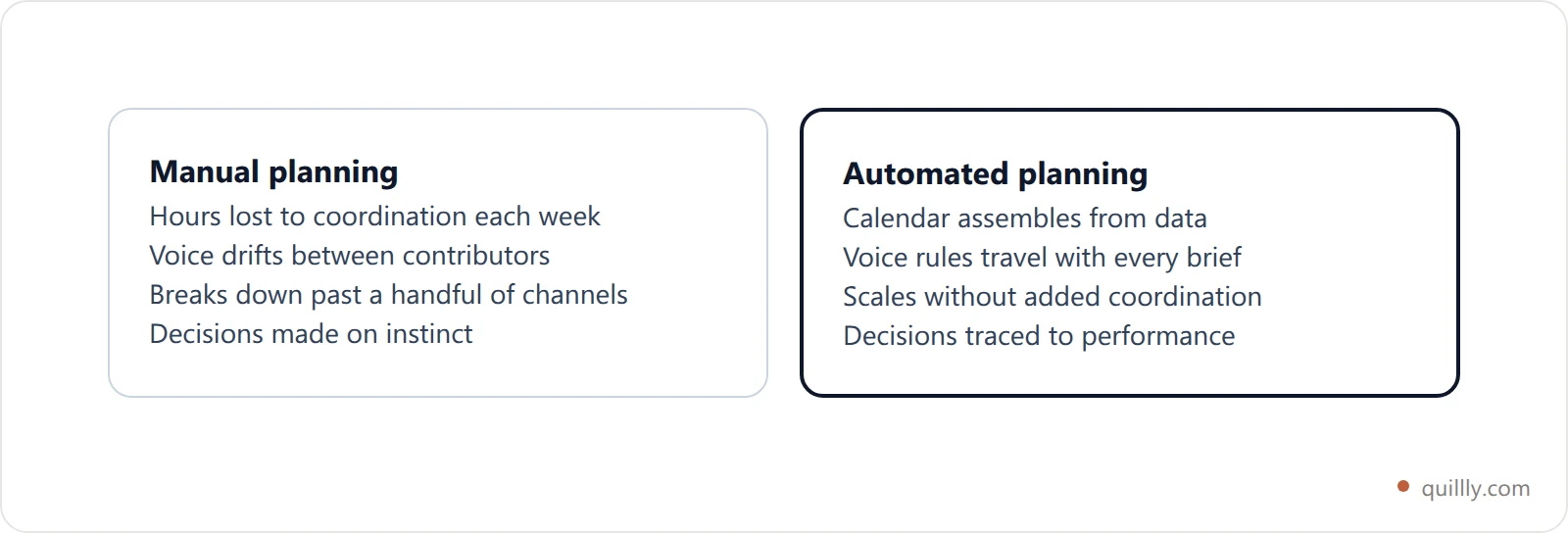
Time Drain: Manual research, calendar management, and coordination between team members consume 20-30% of marketing time that could drive actual results.
Inconsistency: Without systematic planning, content quality and posting frequency fluctuate wildly, damaging brand credibility and audience engagement.
Scalability Barriers: Growing content demands quickly overwhelm small teams, forcing businesses to choose between quality and quantity.
These challenges explain why 60% of small businesses struggle to maintain consistent content production, directly impacting their ability to compete with larger organizations that have dedicated content teams.
Core Benefits of Automated Content Planning#
Dramatic Time Savings#
Automated planning tools eliminate the manual work that traditionally consumes hours each week. Instead of researching topics, coordinating calendars, and managing spreadsheets, businesses can focus on strategy and creative development. Companies report saving 15-20 hours weekly after implementing automation.
Consistent Brand Messaging#
Automated systems maintain your brand voice across all content by using predefined guidelines and tone parameters. This consistency builds trust with audiences and strengthens brand recognition over time.
Scalable Content Production#
Automation enables small businesses to scale content production without proportional increases in time or resources. What previously required a team of five can now be accomplished by one person using intelligent tools.
Data-Driven Optimization#
Modern planning tools analyze performance data to suggest improvements, optimal posting times, and content types that resonate with your audience. This insight transforms guessing into strategic decision-making.
Key Features of Effective Automated Planning Systems#
Intelligent Content Calendars#
Advanced systems create dynamic content calendars that adapt to performance data, seasonal trends, and business priorities. They automatically balance different content types while maintaining optimal posting frequencies.
Brand Voice Integration#
Quality automation tools incorporate your unique brand voice, ensuring all generated content maintains consistency while scaling production. This feature prevents the generic, robotic tone that plagues many automated systems.
Multi-Platform Coordination#
Effective planning coordinates content across multiple channels—blogs, social media, email campaigns—ensuring cohesive messaging and maximum reach without manual coordination overhead.
Performance Analytics Integration#
The best systems connect with analytics platforms to automatically adjust future content based on what performs best with your specific audience.
Small Business Content Strategy: Making Automation Work#
A successful small business content strategy using automated planning requires strategic implementation. Small businesses that integrate automated content planning into their overall content strategy see 40% better results than those using automation in isolation.
The key lies in aligning automated planning with specific business objectives. Rather than automating random content creation, successful small businesses use automation to support targeted campaigns, seasonal promotions, and customer journey mapping.
Content strategy automation works best when it supplements human creativity rather than replacing it entirely. The most effective approach combines automated planning for efficiency with human oversight for strategic direction and quality assurance.
Implementation Strategy for Small Businesses#
Start With One Channel#
Begin by automating planning for your most important content channel, typically your blog or primary social platform. Master one area before expanding to avoid overwhelming your team or diluting quality.
Define Clear Brand Guidelines#
Document your brand voice, preferred topics, and content standards before implementing automation. Clear guidelines ensure the system produces content that aligns with your business identity.
Set Measurable Goals#
Establish specific metrics for success—content frequency, engagement rates, lead generation—to evaluate automation effectiveness and guide optimization efforts.
Gradual Expansion#
Once initial automation proves successful, gradually expand to additional channels and content types. This measured approach prevents quality issues while maximizing learning opportunities.
Common Implementation Challenges#
Over-Automation Concerns#
Some businesses worry that automation creates generic content. Modern AI tools actually enhance personalization by analyzing audience behavior and preferences to create more targeted content than manual methods typically achieve.
Integration Complexity#
Connecting automation tools with existing systems can seem daunting. Most platforms now offer simple integrations with popular marketing tools, making setup straightforward for non-technical users.
Quality Control#
Maintaining content quality requires initial setup time to configure brand parameters and review early outputs. This upfront investment pays dividends through consistently high-quality automated content.
Budget Constraints#
Small businesses often assume automation requires significant investment. However, many platforms offer scalable pricing that makes automation accessible to businesses of all sizes, with ROI typically achieved within the first quarter of implementation.
For industry-wide numbers to benchmark against, the Content Marketing Institute's annual research is the standard reference.
Measuring Success#
Track these key metrics to evaluate your automated content planning:
Planning Efficiency: Measure time saved in content planning and coordination activities.
Content Consistency: Monitor posting frequency and brand voice alignment across all content.
Engagement Growth: Track improvements in audience engagement, shares, and comments.
Lead Generation: Measure increases in qualified leads generated through content marketing efforts.
ROI Improvement: Calculate return on investment by comparing automation costs to increased revenue from improved content marketing performance.
Advanced Automation Techniques#
Predictive Content Scheduling#
Sophisticated automated planning systems now use machine learning to predict optimal posting times based on audience behavior patterns. This technology ensures your content reaches maximum visibility without manual analysis.
Dynamic Content Adaptation#
Advanced systems automatically adjust content based on real-time performance data, ensuring your strategy remains aligned with audience preferences and market conditions.
Cross-Channel Synchronization#
Modern automation coordinates content across multiple platforms simultaneously, maintaining brand consistency while optimizing for each channel's unique requirements and audience expectations.
Future of Automated Content Planning#
As we progress through 2026, automated content planning continues evolving with more sophisticated AI capabilities. Predictive analytics now forecast content performance before publication, while advanced personalization creates unique content experiences for individual audience segments.
Small businesses that embrace these technologies today position themselves ahead of competitors still relying on manual planning methods. The gap between automated and manual content planning continues widening, making adoption increasingly critical for sustained growth.
Industry Trends and Statistics#
Recent market research indicates that 78% of small businesses using automated content planning report significant improvements in their overall marketing effectiveness. Additionally, companies implementing these systems see an average 250% increase in content output within six months.
The trend toward automation reflects broader industry shifts toward efficiency and data-driven decision-making. Small businesses that adapt to these changes position themselves competitively against larger organizations with more resources.
Getting Started Today#
Implementing automated content planning doesn't require massive budgets or technical expertise. Modern platforms like Quillly provide intuitive interfaces that guide small businesses through setup while delivering enterprise-level capabilities.
Start by identifying your primary content challenges—time constraints, consistency issues, or scaling difficulties. Then explore automation tools that specifically address these pain points. Most platforms offer trial periods, allowing you to test effectiveness before committing resources.
The investment in automated content planning pays immediate dividends through time savings and improved content performance. More importantly, it positions your business for sustainable growth in an increasingly competitive digital landscape.
Frequently Asked Questions#
What is automated content planning?#
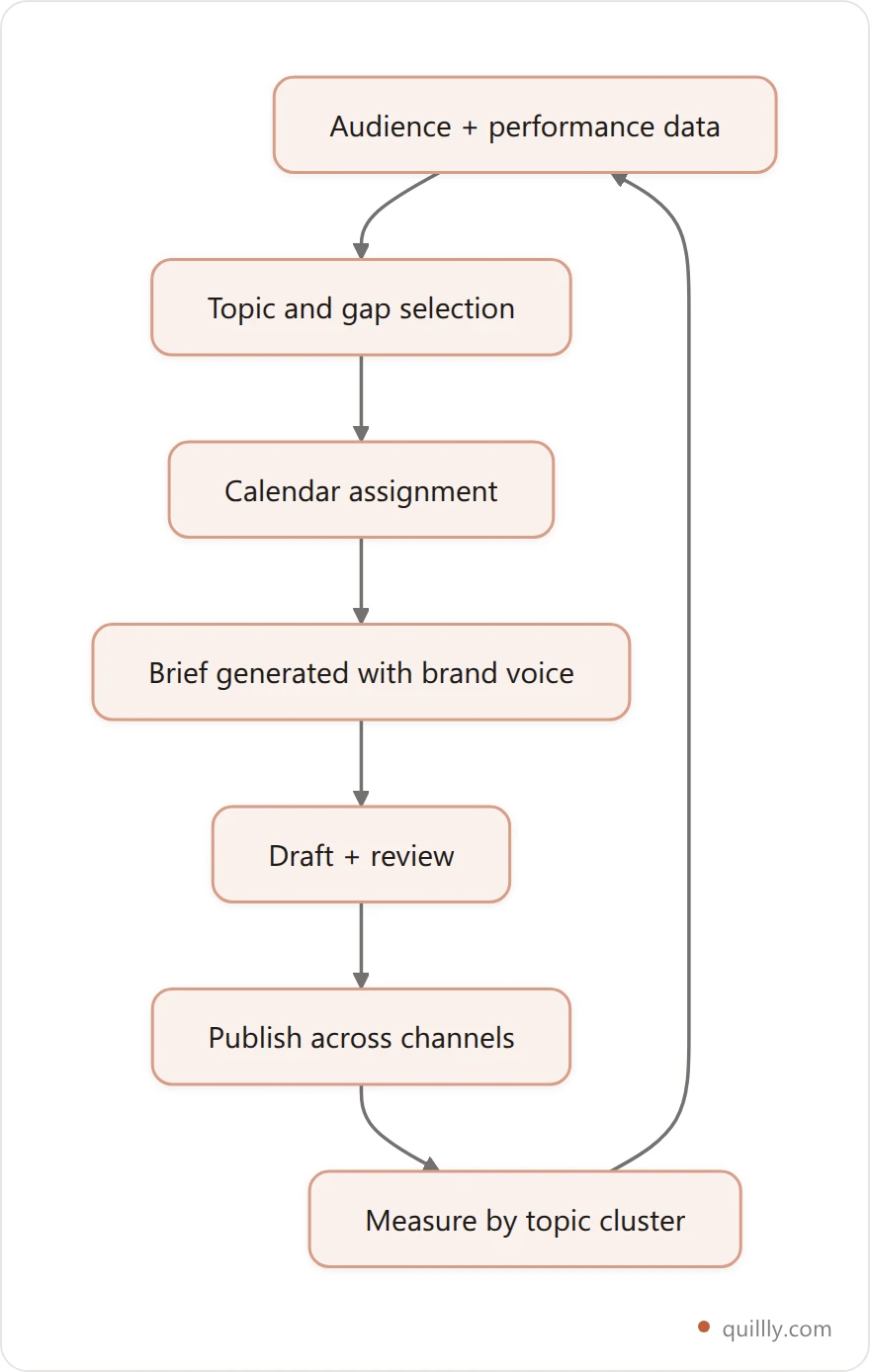
It is using data and AI to decide what to publish and when, instead of filling a calendar by hand. The system reads audience and performance signals, proposes topics that close real gaps, assigns them to dates, and generates briefs carrying your brand voice.
Does automated planning replace a content strategist?#
No. It removes the coordination work — scheduling, briefing, chasing — and leaves the judgment calls: which audience to serve, which bets to take, what to say no to. Teams that expect it to supply strategy end up with a very efficient calendar of forgettable posts.
How small does a team have to be for this to be worth it?#
One person is enough. Solo operators benefit most because coordination overhead falls entirely on them. The payoff shows up as consistency, since automated planning keeps publishing on schedule during the weeks when everything else is on fire.
What data does automated content planning need?#
Less than most teams think. Search Console queries, your existing post performance, and a documented brand voice cover the essentials. Waiting for a complete analytics stack is the most common reason teams never start.
How do you keep an automated calendar from going stale?#
Close the loop. Feed published-post performance back into topic selection so the next cycle reflects what actually worked. A calendar that generates topics but never reads results is automation without the learning, and it drifts within a quarter.
Conclusion#
Automated content planning represents a fundamental shift in how small businesses approach content marketing strategy. By eliminating manual planning bottlenecks while ensuring consistent brand messaging, automation enables small businesses to compete effectively with larger organizations.
The combination of time savings, improved consistency, and scalable production makes automated planning an essential tool for any small business serious about content marketing success in 2026 and beyond.
Ready to transform your content planning process? Start a free 14-day Quillly trial — AI-powered blog generation, brand voice configuration, and direct domain publishing in one platform.
For related reading, explore our guides on AI content governance for small businesses, AI blog automation in 2026, and content automation tools that save 30+ hours monthly.