

The AI Content Personalization Gap Nobody Is Talking About#
AI content personalization is one of the most discussed topics in marketing — yet most of the conversation stops at the subject line. Add a first name, run an A/B test on the headline, call it "personalized." Done. Except it isn't done, and your subscribers know it.
Consider this: 44% of consumers say most marketing emails they receive aren't relevant to them, and 84% of brands do not excel at differentiating through personalization, according to Emarsys's personalization research. That's nearly half your list tuning out before they scroll past the preview text. The irony is almost painful — the data, the tools, and the intent are all present, but the execution is stuck at the surface level.
Here's the deeper problem: 79% of marketers already use AI to personalize content and campaigns, but only 39% use it to build genuinely new customer experiences. Adoption is near-universal; depth is not. That gap — between running AI on your email and actually changing what each subscriber reads — is where most small businesses are silently losing revenue.
True email personalization doesn't live in the subject line. It lives in the body — in AI-generated product recommendations, behavioral-trigger copy blocks that respond to what a user actually did, and predictive micro-segmentation that determines which version of an email each subscriber sees. The good news? SMBs now have affordable, accessible tools to execute all three layers without an enterprise budget or a dedicated engineering team.
This guide covers everything you need to close the gap in email personalization for small businesses: why subject-line tactics alone are leaving money on the table, a clear three-layer framework for body personalization, a step-by-step 4-week implementation playbook, the KPIs that actually matter, and the data-privacy guardrails every SMB must have in place before scaling.
Why Subject-Line Personalization Alone Is Leaving Money on the Table#
Let's put some numbers on the problem before we talk about solutions.

The Personalization Gap in Hard Numbers#
The consumer frustration with irrelevant email is well-documented and growing:
40% of consumers feel brands don't understand them as a person
33% of subscribers say brands don't personalize content to their needs
44% find most marketing emails irrelevant — meaning nearly half your sends are generating indifference at best, unsubscribes at worst
All three come from the same Emarsys personalization dataset, drawn from SAP's 2025 consumer research.
These aren't abstract sentiment scores. They translate directly into open rates that plateau, click-through rates that stagnate, and conversion rates that never improve no matter how much you optimize your send time or tweak your preheader text.
Why First-Name Tokens Are Table Stakes, Not Strategy#
Most SMBs — and frankly, many mid-market businesses — treat personalization as a two-step process: insert {{first_name}} in the subject line, run an A/B test on the headline copy, and declare victory. This approach was differentiated in 2015. In 2026, it's the baseline expectation, not a competitive advantage.
The problem isn't awareness — it's execution depth. The 84% of brands that fail to excel at personalization aren't failing because they don't know personalization matters. They're failing because they've conflated "personalization" with "name insertion" and moved on.
Meanwhile, the conversion opportunity sitting untouched is significant. The techniques that change the body of the email — dynamic content blocks, behavioral triggers, AI-generated copy variations — remain far less common than subject-line tokens, which is exactly why they still have room to move your numbers. Measure your own lift against a holdout group rather than trusting any vendor's headline percentage.
Why the Gap Persists#
Three factors explain why most SMBs haven't closed this gap yet:
Perceived technical complexity. Dynamic content blocks and behavioral triggers sound like enterprise engineering projects. They're not — but the perception persists.
Tool fragmentation. Data lives in one platform, email lives in another, and the AI layer is a third tool entirely. Without a clear workflow connecting them, nothing gets implemented.
No repeatable system. Most "personalization guides" list tools without showing how to wire them together into a process a small team can run consistently.
The gap isn't a data problem. Most SMBs have more behavioral data than they're using. It's a workflow and implementation problem — which is exactly what the rest of this guide addresses.
For a broader look at how AI tools are transforming small business marketing ROI, see our deep-dive on AI Marketing Tools: How Small Businesses Achieve 450% ROI with Intelligent Automation in 2026.
The Three Layers of AI Content Personalization in Email#
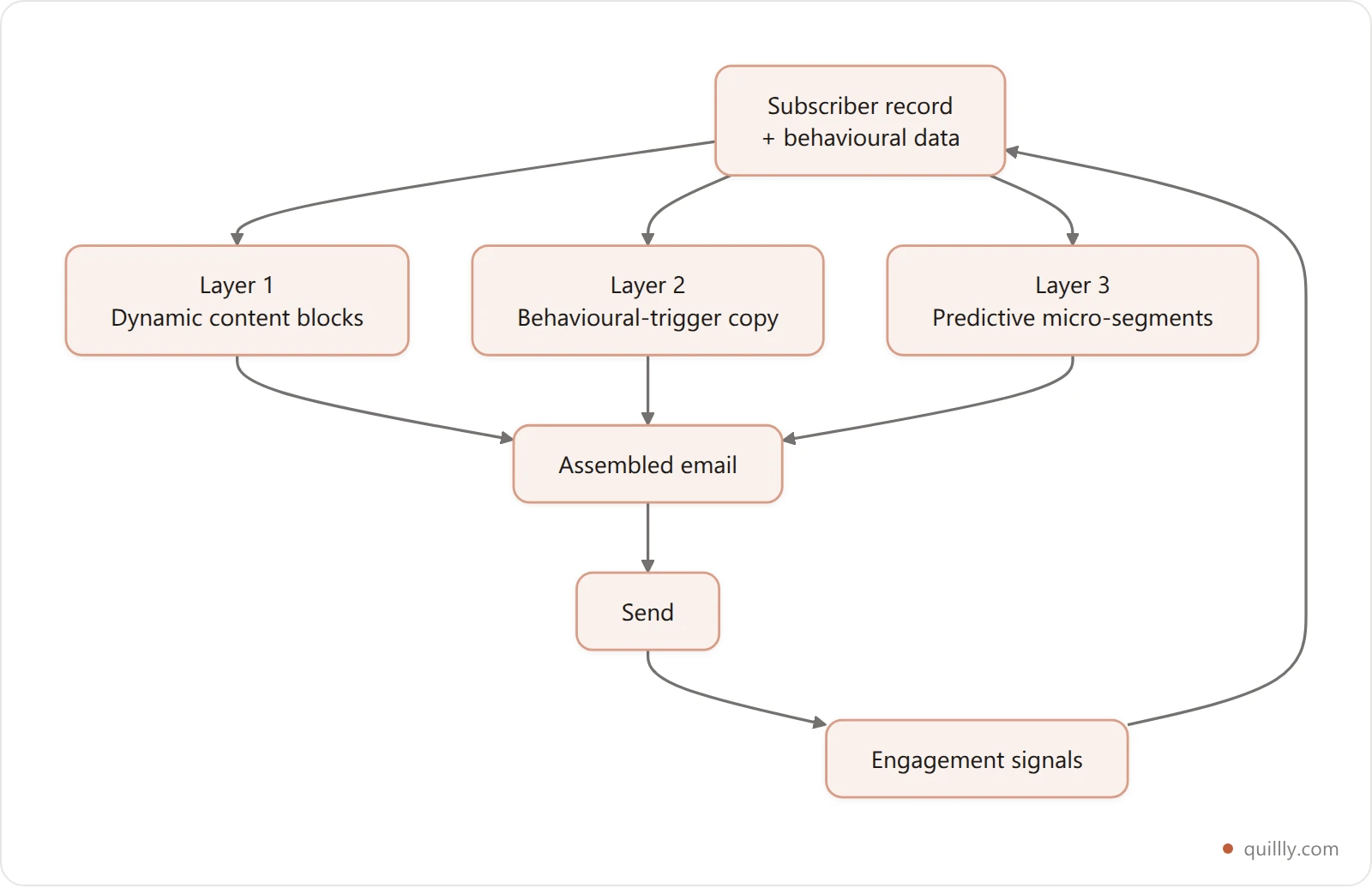
Before diving into tactics, it helps to have a clear mental model. AI-powered email body personalization operates on three distinct layers — and all three must work together to generate meaningful conversion lift.
Layer 1: Dynamic Content Blocks (Product and Service Recommendations)#
This is the foundation. Dynamic content blocks are sections of your email body that swap out automatically based on subscriber attributes — purchase history, browsing behavior, location, industry, or lifecycle stage. A subscriber who bought running shoes last month sees a block featuring hydration gear. A subscriber who browsed your pricing page but didn't convert sees a block featuring a case study and a limited-time offer.
Tools like ActiveCampaign, Mailchimp's AI features, and Rasa.io make this accessible at price points starting around 20–30 USD per month. The key is connecting your behavioral data source (your CRM, your e-commerce platform, your website analytics) to your email platform so the right block appears for the right subscriber automatically.
Layer 2: Behavioral-Trigger Copy (AI-Written Paragraphs Based on User Actions)#
The second layer goes beyond block swapping. Behavioral-trigger copy uses AI to generate or select entire paragraphs of email body content based on what a subscriber has recently done — or not done. Abandoned a cart? The AI generates urgency copy tailored to the specific product left behind. Completed onboarding step two but stalled on step three? The AI surfaces a paragraph addressing the exact friction point that typically causes drop-off at that stage.
This is where platforms like Copy.ai and similar AI writing tools enter the workflow — generating brand-consistent copy variations at scale that would take a human writer hours to produce manually.
Layer 3: Predictive Segmentation (AI Micro-Segments)#
The third layer is the intelligence engine behind layers one and two. Predictive segmentation uses machine learning to group subscribers into micro-segments based on behavioral patterns, predicted lifetime value, churn risk, and engagement likelihood. Instead of manually building five audience segments, you're working with AI-generated cohorts that update dynamically as subscriber behavior evolves.
This layer determines which version of your email each subscriber sees — and it does so continuously, not just at campaign launch. All three layers must operate as a unified workflow, not isolated tactics. Dynamic blocks without behavioral triggers produce generic swaps. Behavioral triggers without predictive segmentation produce well-written copy delivered to the wrong people. Together, they create genuinely personalized content experiences that subscribers actually notice.
The same three-layer logic applies to every channel you publish on — see how AI content personalization works for your blog.
Step-by-Step Implementation Playbook for SMBs#
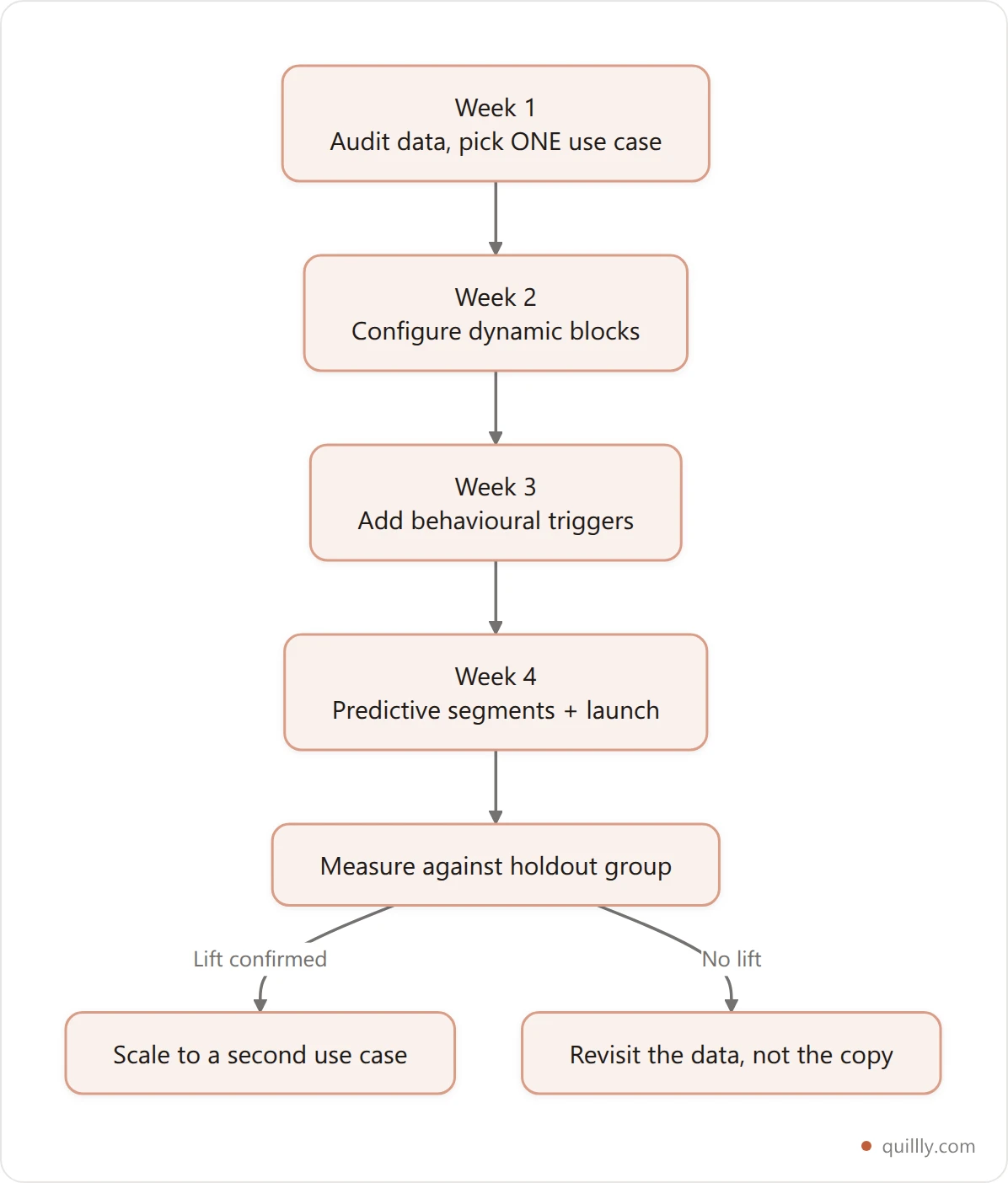
The reason most SMBs never implement advanced personalization isn't budget — it's the absence of a concrete, repeatable system. Here's a 4-week launch framework built for small teams using tools in the 20–50 USD per month range.
Week 1: Audit Your Data and Define One High-Impact Use Case#
Don't try to personalize everything at once. Start by auditing what behavioral data you already have: purchase history, email click patterns, page visits, form completions. Then identify the single use case with the highest potential lift — typically abandoned cart recovery, post-purchase upsell, or re-engagement of lapsed subscribers.
Map the data you have to the use case you've chosen
Identify the gap between the data you have and the data you need
Set a baseline: document your current conversion rate for this specific email flow before any changes
Week 2: Configure Your Dynamic Content Layer#
With your use case defined, set up your first dynamic content block:
Choose your email platform's dynamic content feature (ActiveCampaign's conditional content, Mailchimp's dynamic content blocks, or a dedicated tool like Rasa.io for newsletter personalization)
Build two to three content block variations mapped to your key segments
Connect your data source — even a simple CSV export from your CRM works to start
Test rendering across devices and email clients before going live
The goal this week is one working dynamic block, not a fully personalized email system. Scope discipline is what makes the 4-week timeline realistic.
Week 3: Add the Behavioral-Trigger Copy Layer#
Now layer in AI-generated copy variations for your trigger email:
Use an AI writing tool to generate three to five copy variations for your trigger scenario (abandoned cart, lapsed subscriber, post-purchase)
Brief the AI with your brand voice guidelines — tone, vocabulary, what to avoid
Run each variation through your editorial review process (even a 10-minute human review catches brand inconsistencies)
Map each copy variation to the corresponding subscriber segment from Week 2
If you're concerned about maintaining brand consistency as you scale AI-generated copy, our guide on Human-in-the-Loop AI Content Creation walks through exactly how to build that editorial layer without slowing down your workflow.
Week 4: Activate Predictive Segmentation and Launch#
In the final week, activate your AI segmentation layer and launch:
Enable your email platform's AI segmentation features (most platforms at the 30–50 USD/month tier include basic predictive send-time and engagement scoring)
Set up a holdout group — 10–15% of your list that receives the non-personalized version — so you can measure lift attributable specifically to personalization
Launch your first AI-personalized email flow
Schedule a Week 5 review to analyze results before expanding to additional use cases
The principle: prove lift on one use case, then scale. Trying to personalize six email flows simultaneously in week one is the fastest path to a stalled implementation.
Run the same playbook on your blog
Your AI drafts, Quillly scores every post against 14+ SEO criteria and publishes it straight to your own domain — the publishing half of the stack, without a CMS in the middle.
Start the 14-day trialMeasuring What Actually Matters: KPIs for AI-Driven Email Personalization#
Most SMBs track open rates. Open rates will not tell you whether your AI personalization investment is working. Here's the KPI framework that will.
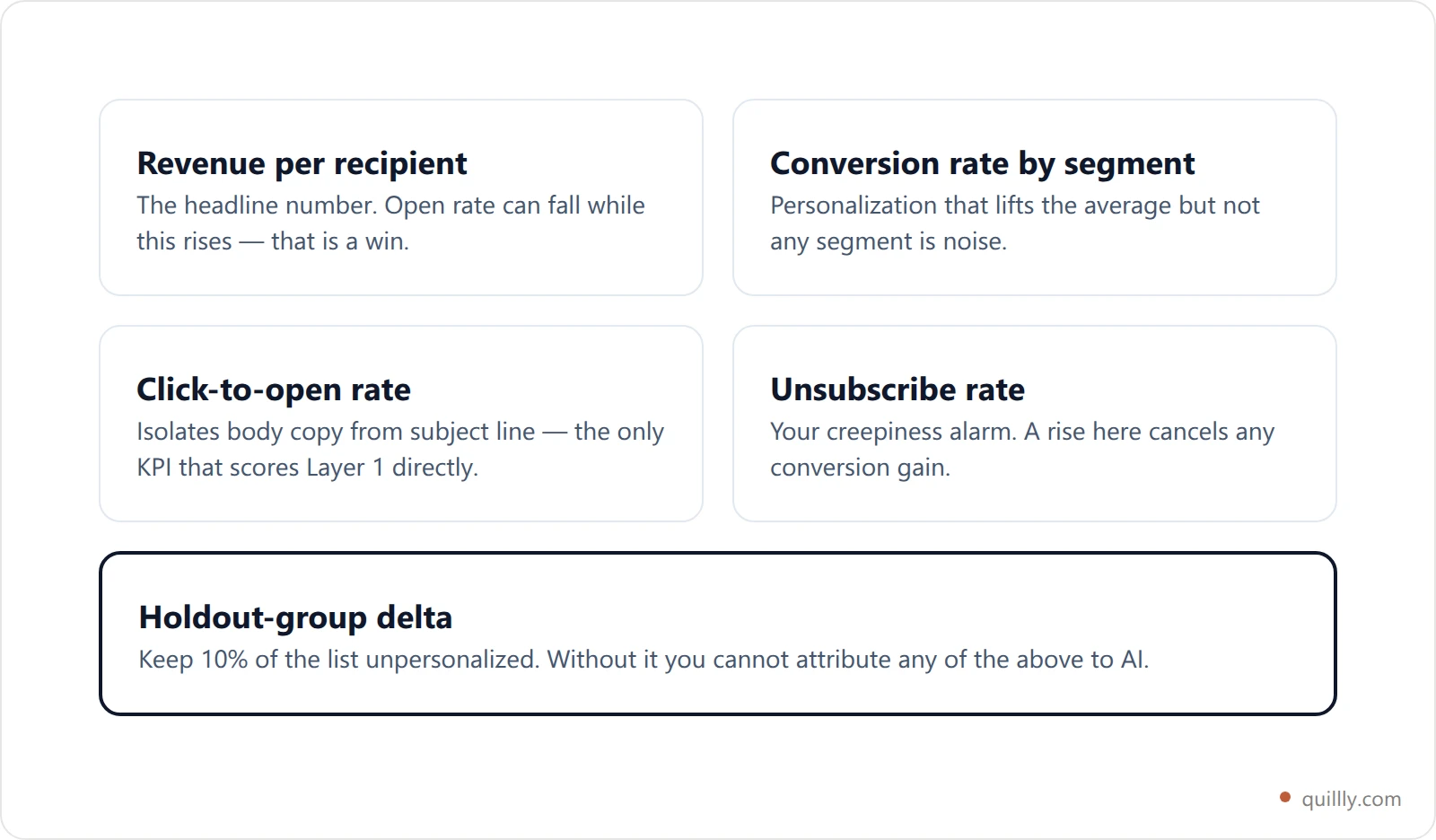
The Five KPIs That Reveal True Personalization Lift#
KPI | What It Measures | Why It Matters |
|---|---|---|
Click-to-conversion rate | Clicks that result in a purchase or goal completion | Isolates body content effectiveness from subject-line effects |
Revenue per email sent | Total revenue divided by emails delivered | Ties personalization directly to business outcomes |
Segment-level engagement rate | Open + click rates by AI micro-segment | Shows which segments respond best to which content variations |
Unsubscribe rate by variant | Unsubscribes per email variant | Flags content that feels intrusive or irrelevant |
Holdout lift | Conversion rate of personalized group vs. control group | Isolates AI's contribution from other variables |
How to Isolate AI's Contribution#
The holdout methodology is the most important measurement practice on this list. By keeping 10–15% of your list on the non-personalized version, you create a clean comparison that removes confounding variables — seasonal effects, promotional offers, list growth — from your analysis.
Measurement discipline is the same skill that separates a working content programme from a busy one — you can score your own pages the same way.
Review your holdout data at 30, 60, and 90 days. Short-term lift can be a novelty effect. Sustained lift across 90 days is evidence that your personalization is genuinely improving subscriber experience, not just temporarily boosting engagement.
For a broader framework on measuring small business marketing automation ROI, including email and beyond, that linked guide covers attribution methodology in depth.
Data Privacy and Security: What Every SMB Must Know Before Personalizing at Scale#
Feeding customer behavioral data into AI tools raises legitimate questions — and your subscribers are increasingly aware of how their data is being used. Getting this right isn't just a compliance checkbox; responsible personalization is a genuine competitive advantage.
Four Actionable Guardrails for SMBs#
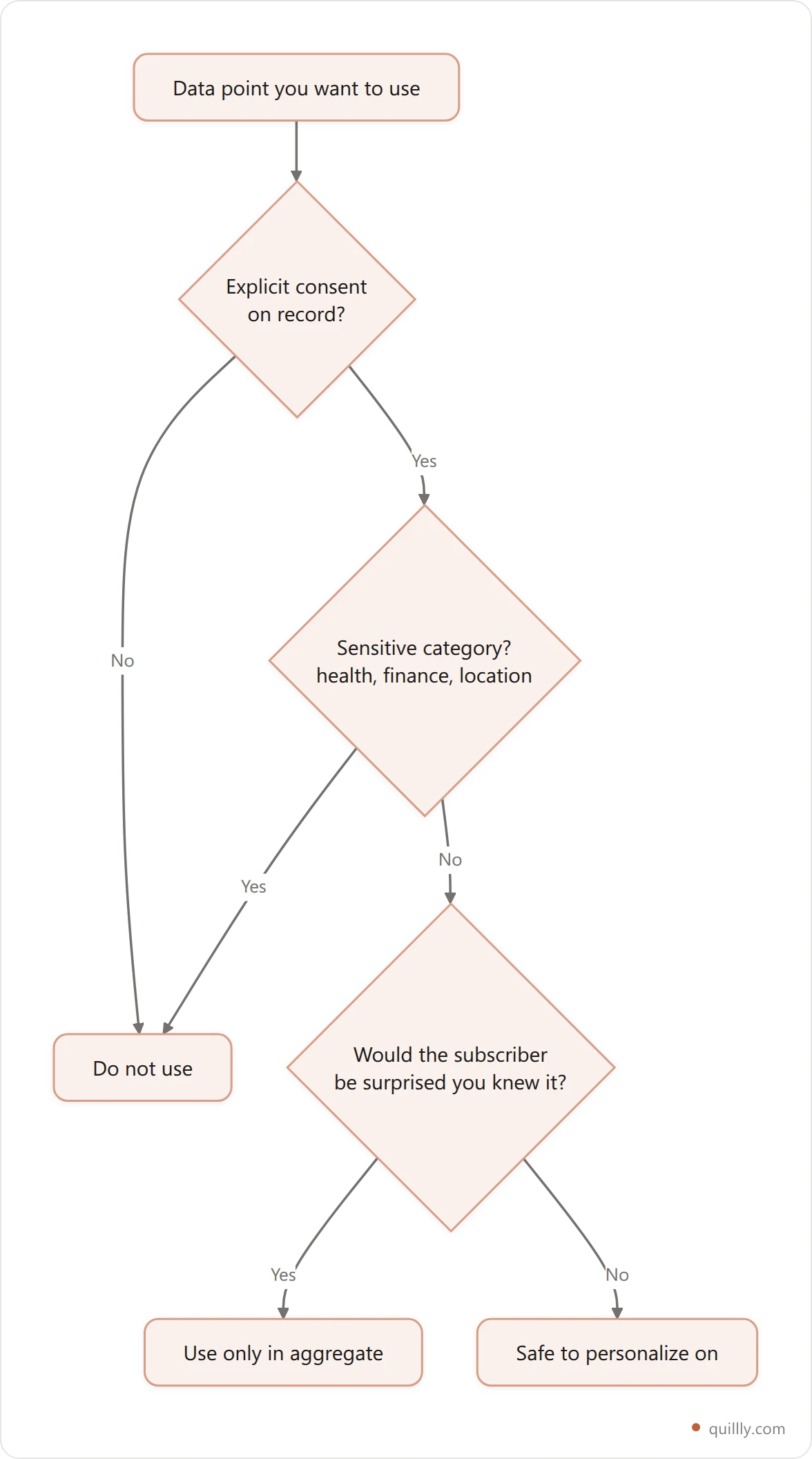
1. Use first-party data first. The behavioral data your subscribers have explicitly generated by interacting with your emails, website, and products is the safest and most effective personalization fuel. Avoid purchasing third-party data lists to feed your AI segmentation — the quality is poor and the compliance risk is real.
2. Be transparent in your privacy policy. Your privacy policy should clearly state that you use behavioral data to personalize email content. This isn't just a legal requirement under regulations like GDPR and CCPA — it's increasingly what subscribers expect before they trust a brand with their attention.
3. Audit your AI tool's data handling practices. Before connecting your CRM or e-commerce platform to any AI personalization tool, review how that tool stores, processes, and potentially shares your customer data. Look specifically for data processing agreements (DPAs) and whether the tool offers data residency options if your subscribers are in regulated jurisdictions.
4. Give subscribers meaningful control. A preference center that lets subscribers indicate content interests — product categories, communication frequency, content types — serves double duty: it improves your personalization data quality and demonstrates respect for subscriber autonomy. Subscribers who choose their preferences are significantly less likely to disengage or report emails as spam.
The bottom line: personalization that feels helpful builds trust. Personalization that feels surveillance-adjacent destroys it. The line between the two is drawn by consent, transparency, and relevance.
Frequently Asked Questions#
What is AI content personalization in email?#
AI content personalization uses subscriber data to change the body of an email, not just the greeting. It covers three layers: dynamic content blocks that swap products, behavioral-trigger copy written in response to an action, and predictive micro-segments that group people by likely intent.
Is subject-line personalization still worth doing?#
Yes, but treat it as table stakes. Subject-line tokens are now near-universal, so they no longer differentiate you from anyone else in the inbox. The body-level layers are far less common, which is precisely why they still have room to move your numbers.
How much subscriber data do you need to start?#
Less than most teams assume. One reliable behavioral signal, such as last product viewed or last category purchased, is enough for a first dynamic block. Teams stall by waiting for a complete data warehouse instead of shipping one use case with the data they already have.
How do you prove AI personalization actually worked?#
Hold back 10% of the list and send them the unpersonalized version. Compare revenue per recipient between the two groups. Without a holdout, seasonality and list growth will happily explain any improvement you see, and you will scale something that never worked.
When does personalization start to feel creepy?#
When it reveals inference rather than memory. Referencing a product someone viewed reads as helpful; referencing something they never told you reads as surveillance. Apply the surprise test: if a subscriber would be startled that you knew it, use it in aggregate only.
Conclusion: Stop Personalizing the Subject Line and Start Personalizing the Conversation#
The personalization gap is real, it's measurable, and it's costing SMBs revenue every day. Forty percent of consumers feel brands don't understand them, 44% find most marketing emails irrelevant, and 84% of brands still fail to differentiate through personalization.
The argument of this guide is simple: the subject line is not the conversation. The body is. And the body is where AI-powered personalization — executed through dynamic content blocks, behavioral-trigger copy, and predictive micro-segmentation — creates the kind of relevance that actually moves subscribers to act.
The Path Forward#
The three-layer framework gives you a clear architecture:
Layer 1 (dynamic content blocks) ensures the right products, services, and offers appear for the right subscriber
Layer 2 (behavioral-trigger AI copy) ensures the language surrounding those offers responds to what the subscriber has actually done
Layer 3 (predictive micro-segmentation) ensures the right version of the entire email reaches the right person at the right time
The 4-week playbook is your entry point. Start with one high-impact use case — abandoned cart, post-purchase upsell, or lapsed subscriber re-engagement. Prove lift using the holdout methodology. Then scale to additional flows with confidence, because you have data, not just intuition, driving the decision.
Measurement is what separates guessing from growing. The five KPIs — click-to-conversion rate, revenue per email sent, segment-level engagement, unsubscribe rate by variant, and holdout lift — give you the dashboard to justify the investment and identify where to optimize next.
Where Quillly Fits In#
The AI copy generation layer — writing brand-consistent email body variations, behavioral-trigger paragraphs, and dynamic content block copy at scale — is exactly the kind of content challenge that AI content personalization tools like Quillly are built to solve. Quillly doesn't write for you — you connect the AI you already use, and Quillly scores each draft against 14+ SEO criteria and publishes it straight to your own domain, so your team spends its time refining and approving rather than copy-pasting.
The same logic that makes AI-powered email body personalization so powerful — generate more relevant content faster, at lower cost, without sacrificing quality — applies directly to your blog and SEO content strategy. If you're ready to extend that personalization-at-scale approach beyond email and into the content that drives your organic search visibility, Quillly is the tool built for exactly that.
Ready to see what AI-powered content generation can do for your business? Start a free 14-day Quillly trial and generate your first SEO-optimized blog post in minutes — no writing experience required, brand voice included.