

Picture 2,000 AI-written articles published across 20 fresh domains. Within 36 days, 71% got indexed by Google. Sounds like a win. Then look at month three: only 3% of those pages were still in the top 100. That 16-month experiment from Search Engine Land is the most honest snapshot of AI autoblogging you'll find.

AI autoblogging means using software to generate and publish blog posts automatically, with little or no human touch between the prompt and the live page. The pitch is irresistible: set a keyword list, walk away, wake up to traffic. The reality is messier, and the gap between "indexed" and "ranking" is where most autoblogs quietly die.
AI autoblogging is the practice of generating and publishing blog posts on autopilot using AI. It still works in 2026, but only when a human gate and real SEO checks sit between the draft and the live page. Pure set-and-forget autoblogging gets filtered fast by Google's scaled content abuse systems.
Here's what the data actually says, why most autoblogs stall at "crawled, currently not indexed," and the four-gate loop that keeps AI content ranking. All of it reflects the March 2026 core update, which sharpened how Google treats content published at scale.
What AI autoblogging actually means in 2026#
AI autoblogging refers to any setup where an AI model writes a post and software publishes it without a person editing each draft. The term used to describe RSS-scraping plugins that stitched stolen snippets together. That version is dead. The 2026 version uses large language models like Claude, GPT, or Gemini to generate original drafts on a schedule.
Three things separate modern autoblogging from the old spam:
The source. Frontier AI writes the draft, not a content-spinner rewording someone else's post.
The pipeline. Posts flow through SEO scoring, internal linking, and sitemap generation before going live.
The destination. Good autoblogs publish to your own domain, not a throwaway subdomain farm.
The word "auto" is doing a lot of work, though. Most tools sell full autopilot. The ones that actually rank keep a human in the loop. That distinction is the whole ballgame, and it's where the data gets uncomfortable for the set-and-forget crowd.
Does AI autoblogging still work? Here's the data#
Short answer: AI autoblogging works for indexing and fails for ranking, unless you add quality control. The numbers make the split obvious.
In the Search Engine Land experiment, 2,000 AI articles across 20 domains hit 70.95% indexation within 36 days. Strong start. But by months three to six, only 3% of pages remained in the top 100. By month 16, the whole network had pulled just 1,381 clicks from 1.09 million impressions. That's a click-through rate near zero.
The prevalence numbers explain why. An Ahrefs study of 900,000 pages found 74.2% of newly created web pages now contain AI-generated content, but only 2.5% are pure AI. Most of the web is human-AI blends. Pure autopilot content competes against edited content and loses.

And enforcement is real. Sites publishing hundreds of unedited AI pages saw 50-80% traffic drops after the March 2026 core update, per coverage of Google's scaled content abuse crackdown. Indexing is easy. Surviving an update is not.
The contrarian truth: set-and-forget is the part that died#
Here's the take most autoblog vendors won't print: autoblogging isn't dead, but set-and-forget autoblogging is. The conventional wisdom that autoblogging means hands-off is exactly the thing Google now filters.
Google has been blunt about this. Danny Sullivan, Google's Search Liaison, put it plainly: "We don't really care how you're doing this scaled content, whether it's AI, automation, or human beings. It's going to be an issue." (via Search Engine Journal).
The trigger isn't AI. It's volume without value. John Mueller framed it the same way in late 2025: "I wouldn't think about it as AI or not, but about the value that the site adds to the web."
So the failure mode of autoblogging isn't the automation. It's removing the human judgment that decides whether a post is worth publishing at all. Take the human out of the loop and you've built a content mill. Keep one checkpoint in, and you've built a publishing engine. Same tools, opposite outcomes.
We counted how often 27 real blogs actually publish#
Autoblog tools sell volume: 30, 60, 100 posts a month. So we measured what working company blogs actually ship. On 13 August 2026 we parsed the RSS feeds of 27 blogs and counted posts by date. The median blog published 7 posts in the last 30 days. Only 3 of 27 hit 30 or more. The volume autoblogging is sold on is roughly 4x what real blogs sustain.
This matters because velocity is the variable most autoblog buyers control and least understand. If your competitors publish 7 posts a month and you publish 100, you are not out-working them — you are handing Google the exact pattern its scaled-content systems look for.
Cadence measure | Result across 27 blogs |
|---|---|
Median posts, last 30 days | 7 |
Median posts, last 90 days | 12 |
Median posts per year (13 full-archive feeds) | 66 (5.5/month) |
Blogs publishing 30+ in 30 days | 3 of 27 |
Blogs publishing 8+ in 30 days | 13 of 27 |
Blogs publishing nothing in 30 days | 5 of 27 |
Median days since last post | 7 |
The distribution is more useful than the median. One outlier (Vercel, at 120 posts in 30 days across a very broad feed) drags the mean to 13.3 while the median sits at 7. Strip the outlier and the picture is a blog that ships roughly one or two posts a week, forever. That is the cadence that compounds — not a burst of 100.

The other half of the finding is churn. Five of the 27 blogs published nothing at all in 30 days, and three had gone quiet for more than 90. Consistency, not peak volume, is what separates the feeds that keep shipping from the ones that stalled — the same conclusion our own 41-posts-in-a-month experiment reached from the opposite direction. For the fuller treatment, see our breakdown of how often you should actually publish blog posts.
Method and limits. We fetched each blog's public RSS or Atom feed on 13 August 2026 and parsed pubDate, dc:date, or Atom published/updated per entry. Two limits shape how far you can push these numbers. First, many feeds are truncated — HubSpot returned exactly 50 entries and Semrush exactly 20, so their 30- and 90-day counts are floors, not true totals; only the 13 feeds whose archive reached back past 12 months support the 66-posts-per-year figure. Second, a quiet feed is not proof of a quiet blog: one feed in our sample returned entries years old, which almost certainly means we hit a legacy endpoint rather than that the company stopped publishing. We are reporting feed behaviour, which is a good proxy for cadence and a bad proxy for corporate intent.
Why most autoblogs stall at "crawled, currently not indexed"#
If you run an autoblog for more than a week, you'll meet this status in Search Console: "Crawled - currently not indexed." It means Google fetched your page, looked at it, and chose not to add it. For autoblogs, this is the number one silent killer.
Why it happens to automated content specifically:
Thin or templated bodies. Posts that follow an identical skeleton read as low-effort at scale.
No internal links. Orphan pages give Google no reason to trust or prioritize them.
Duplicate intent. Ten posts targeting near-identical keywords cannibalize each other.
Zero freshness signal. Nothing updates after publish, so the page looks abandoned.
The Search Engine Land data showed this by niche. Competitive verticals indexed worst: Finance landed only 9 of 100 pages, Health just 14 of 100. Evergreen niches did far better. The lesson is that Google's bar scales with topic difficulty, and autopilot content rarely clears it. If you're fighting this, our fix stack for blogs Google won't index walks through the exact recovery steps.

What this looked like on our own domain#
We can be specific here, because we did it to ourselves. quillly.com published 41 posts in a single month at an average on-page SEO score of 90. Ninety days later that library had produced 15 clicks from 9,206 impressions — a 0.16% CTR at an average position of 41.5. Roughly a third of the posts were never indexed at all.
The two lessons were not the ones we expected.
Publishing velocity was the problem, not writing quality. An A-grade post is still a 138th page competing for the same finite crawl budget. Once new posts stopped being indexed entirely, every additional post lowered the odds for the ones already waiting.
Internal links did not rescue the stalled pages. Our most heavily linked stuck post carried 31 inbound internal links from indexed pages and stayed on "Crawled – currently not indexed" regardless. Across 22 stuck posts the median was 6 inbound links. Orphan status explains Discovered; it does not explain Crawled. By the time Google has read the page, the verdict is about what the page says, not how well it is wired up.
The honest read for anyone running an autoblog: if your posts are getting crawled and declined, adding more posts and more links is the wrong instinct. Slow down, and give each page one thing — a number, a test, a screenshot — that no other result on the SERP can copy.
The four-gate autoblog loop#
The fix isn't to stop automating. It's to put gates in the pipeline. Call it the four-gate autoblog loop: a publishing flow where nothing reaches your domain until it clears four checkpoints. This is the model that separates a ranking autoblog from a filtered one.
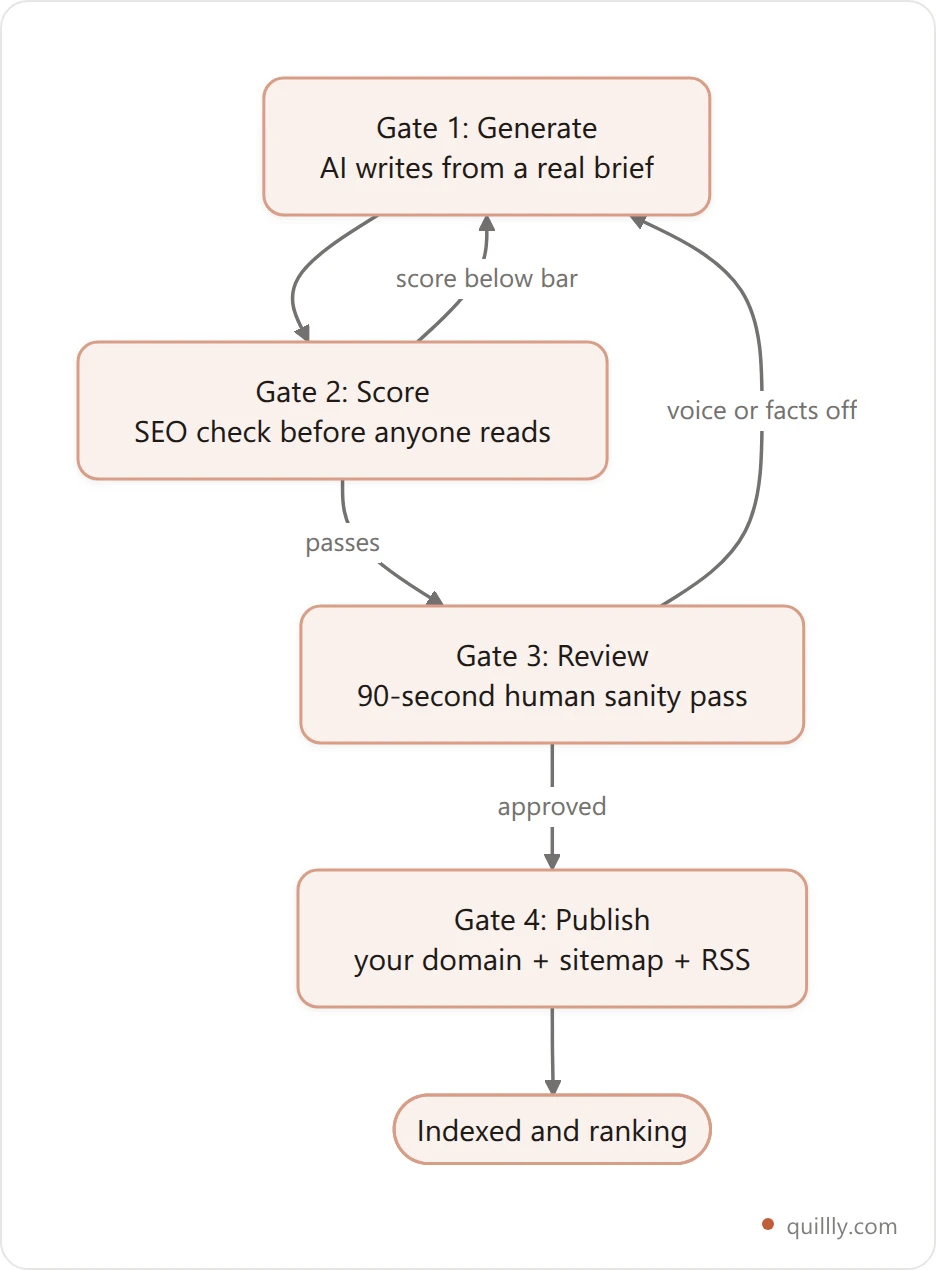
Generate. Your own AI writes the draft from a real brief, not a bare keyword. Give it audience, angle, and intent.
Score. The draft passes an SEO check before anyone looks at it. Headings, meta tags, internal links, readability, and word count all get graded.
Review. A human reads it once. Not a full rewrite, just a 90-second sanity pass for accuracy and voice.
Publish. Only approved drafts go live, straight to your own domain with a sitemap ping and RSS update.
The loop keeps the speed of automation but adds the judgment Google rewards. You can run it for one post a week or fifty. The gates don't change. That's why it scales without turning into a content mill, and why "controlled autoblogging" beats autopilot every time.
Set-and-forget vs controlled autoblogging#
The difference between the two approaches isn't subtle once you line them up. One optimizes for volume. The other optimizes for survival.
Factor | Set-and-forget autoblogging | Controlled autoblog loop |
|---|---|---|
AI model | Locked to the tool's model | Your own (Claude, GPT, Gemini) |
SEO check | None or basic | Scored before review |
Human review | Skipped | One 90-second pass |
Publish target | Subdomain or tool's domain | Your own domain |
Indexing outcome | Stalls at "crawled, not indexed" | Indexed and linked |
Scaled-abuse risk | High | Low |
Survives core updates | Rarely | Usually |
The set-and-forget column is what the 3%-survival data describes. The controlled column is what edited, human-AI blend content looks like, the 74.2% of pages that actually compete. Picking the right column matters more than picking the right tool. For the deeper version of this comparison, see our breakdown of why AI blogs don't rank and how to fix it.
How to autoblog without WordPress, on your own domain#
You don't need WordPress, plugins, or a copy-paste shuffle to run a controlled autoblog. The newer path uses MCP (Model Context Protocol), a standard that lets AI tools like Claude, ChatGPT, and Cursor talk directly to a publishing backend.
The flow looks like this: you brief your AI, it writes, it scores the draft, you approve, it publishes to yourdomain.com/blog. No WordPress admin, no FTP, no plugin patchwork. The post lands on a subdirectory of your real domain, which keeps all the SEO equity on the site you own. (If you're weighing the structure question, our guide to adding a blog without WordPress covers the subdirectory math.)

This is the wedge that makes controlled autoblogging practical. Your AI writes. The infrastructure layer handles SEO scoring, internal linking, sitemap and RSS generation, and the publish step. You stay in the loop for the one thing only a human should do: deciding the post is good enough to ship.
The copy-paste controlled autoblog workflow#
Here's a workflow you can save and reuse. It turns the four-gate loop into actual steps inside an MCP-connected AI like Claude or Cursor. Quillly exposes these as tools your AI calls directly.
Step 1 — Brief the draft. Don't hand the AI a bare keyword. Give it a brief:
Write a 1,500-word post on "best CRM for freelancers."
Audience: solo consultants. Intent: commercial comparison.
Include a comparison table, 3 sourced stats, and an FAQ.
Front-load the answer in every section.
Step 2 — Generate and save the draft. The AI calls create_content to save it to your domain as a draft, never live yet.
Step 3 — Score before you read. The AI runs check_blog_seo. You get a 0-100 score across criteria like meta tags, heading structure, internal linking, and readability. Below 85? It calls get_blog_seo_patches and applies fixes automatically.
Step 4 — Your 90-second review. Read the draft once. Check the facts and the voice. This is gate three, and it's the gate the failed autoblogs skip.
Step 5 — Publish to your domain. Approve it, and the AI calls publish_content. The post goes live on your subdirectory with sitemap and RSS updated. That's the whole loop, and it runs in one conversation.
Save that five-step sequence. It's the difference between an autoblog that compounds and one that gets filtered. A quick SEO gate before publishing is also something you can run by hand with any blog SEO checker if you're not on MCP yet.
Before and after: what a human gate does to the numbers#
Numbers beat opinions, so use the public experiment as the before-and-after.
Before (pure autopilot): The 2,000-page network indexed at 71% but collapsed to 3% top-100 survival, ending at 1,381 clicks across 16 months. That's the set-and-forget ceiling. High volume, near-zero return.
After (adding fresh, edited content): The same researcher's March 2026 follow-up showed what happened when sites kept publishing genuinely useful content instead of abandoning the pages. Older posts got lifted dramatically: a business site saw a 17x impression increase, a law site 19x, and a science site 19x.

The variable that changed wasn't the AI. It was editorial effort and ongoing care, the exact thing the four-gate loop bakes in. Automation got the drafts out fast. Human judgment and freshness got them to rank. If you want the full recovery playbook, our post on whether Google penalizes AI content breaks down the signals that actually move rankings.
Will AI search engines cite your autoblog?#
Ranking in Google is only half the game now. ChatGPT, Perplexity, and Google AI Overviews increasingly decide who gets seen, and they have their own bar. Autoblog content that scrapes through Google's index still has to earn a citation from an answer engine.
Answer engines favor the same signals that survive core updates: clear structure, sourced statistics, direct answers, and original framing. As of 2025, roughly 17% of top 20 search results already contain AI-generated content, so the bar for standing out keeps rising. Generic autopilot posts blend into that 17% and get skipped.
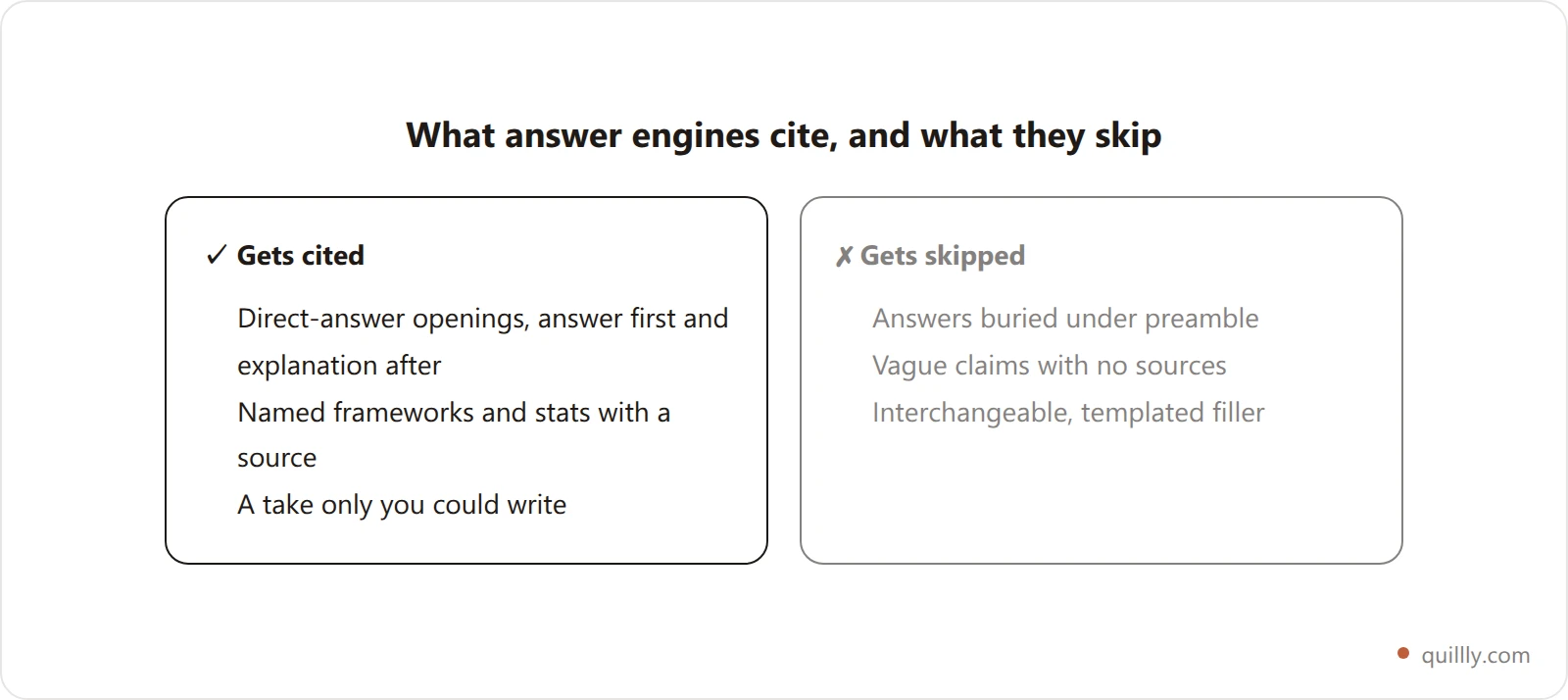
What gets cited instead:
Direct-answer openings. Lead each section with the answer, then explain. Engines lift those sentences.
Named concepts and data. A framework or a stat with a source is quotable. Vague advice isn't.
Real expertise. A take only you could write signals value no content mill can fake.
This is why the review gate matters double in 2026. The same human pass that keeps you out of scaled-abuse trouble also adds the originality answer engines reward. Set-and-forget content can't be cited because there's nothing in it worth quoting. Controlled content can.
When does autoblogging make sense, and when doesn't it?#
Controlled autoblogging earns its keep in specific situations. It's not a fit for everything, and pretending otherwise is how people get burned.
It works well when you have:
A topic cluster to fill. Supporting posts around a clear pillar, where speed compounds into topical authority.
Real expertise to inject. You can add a fact, a screenshot, or a take the AI can't invent. That's your edge over every other autoblog in the niche.
A review habit. You'll actually read each draft before it ships.
It works badly when you want a hands-off money printer in a hard niche like finance or health, or when you plan to publish 100 near-identical pages and hope. Those are the exact patterns the scaled content abuse policy targets. Match the approach to honest expectations and autoblogging is a force multiplier. Treat it as a slot machine and it's a liability.
Where Quillly fits in the loop#
Most autoblog tools lock you into their writer and their domain. The four-gate loop needs the opposite: your AI, your domain, your judgment. That's the gap Quillly fills.
Your AI writes the post inside Claude, ChatGPT, or Cursor. Quillly handles everything after the prompt: SEO scoring across its criteria, internal link suggestions, sitemap and RSS generation, Search Console integration, and the publish step to your own subdirectory. You bring the model and the final yes. The infrastructure handles the unglamorous plumbing that decides whether the post ranks. For the full picture, our complete guide to AI blog publishing maps the entire workflow end to end.
Frequently asked questions#
Does Google penalize AI autoblogging?#
No, Google doesn't penalize autoblogging for using AI. It penalizes low-value content published at scale to manipulate rankings, what it calls scaled content abuse, regardless of whether a human or machine wrote it. Edited, useful AI content ranks fine. Unedited bulk content gets filtered. The automation isn't the problem. The missing quality control is.
Is AI autoblogging worth it in 2026?#
It's worth it if you keep a human in the loop and publish to your own domain. The data shows pure autopilot content collapses, with only 3% of pages surviving in the top 100 after three months. Add SEO scoring and a quick editorial review, and autoblogging becomes a genuine speed advantage rather than a penalty risk.
Can I autoblog without WordPress?#
Yes. Using MCP, AI tools like Claude and Cursor can publish directly to your own domain's subdirectory, no WordPress, plugins, or copy-pasting required. The post lands on yourdomain.com/blog, keeping SEO equity on the site you own. This is often cleaner than a WordPress setup because there's no plugin maintenance or theme conflicts.
How many posts can I autoblog per week safely?#
There's no magic number, only a quality bar. Google's Danny Sullivan said the issue is scaled content "whether it's AI, automation, or human beings." If every post clears a real review gate and adds value, volume is fine. If you're publishing faster than you can review, you've crossed into scaled content abuse territory regardless of count.
What's the difference between autoblogging and AI blog automation?#
Autoblogging implies fully hands-off publishing. AI blog automation, done right, automates the repetitive parts (drafting, scoring, formatting, publishing) while keeping a human checkpoint. The four-gate loop is automation with judgment. Classic autoblogging removes the judgment, which is exactly why so much of it fails to rank.
Why is my autoblog content not getting indexed?#
The usual culprits are thin templated bodies, no internal links, duplicate keyword targeting, and zero updates after publish. Google's "crawled, currently not indexed" status means it saw the page and passed. Fix it by adding internal links, differentiating intent across posts, and keeping content fresh. Indexing follows perceived value, not publish volume.
Is it safe to let AI publish to my website automatically?#
It's safe when a human approves each draft and the tool publishes to your own domain, not a shared one. The risk isn't AI writing. It's publishing unreviewed content at scale. Keep gate three (the human review) in place and automated publishing is no riskier than scheduling a post you wrote yourself.
The bottom line#
AI autoblogging in 2026 is a tale of two columns. Set-and-forget content indexes at 71% but collapses to 3% top-100 survival within three months. Controlled content, the human-AI blend that's now 74.2% of new pages, is what actually competes. The tool matters less than the loop.
Three things to remember. First, the automation isn't what gets penalized, missing quality control is, straight from Google's own Search Liaison. Second, the four-gate loop (generate, score, review, publish) keeps the speed without the penalty risk. Third, publishing to your own domain keeps the SEO equity where it belongs.
Run the loop and autoblogging compounds. Skip the gates and it's a liability. The choice is yours, not the tool's.
Want your AI to actually publish the post it just wrote, on your domain, with the SEO checks built in? Connect Quillly to Claude, ChatGPT, or Cursor in 30 seconds.