

Every list of programmatic SEO examples opens with the same three names: Zapier, Tripadvisor, Canva. They share something nobody mentions — a domain rating north of 500 and the crawl budget that comes with it. Copy their template on a young domain and you get a folder of pages no engine bothers to keep, which is why most collections of pSEO examples are inspiring to read and impossible to act on.
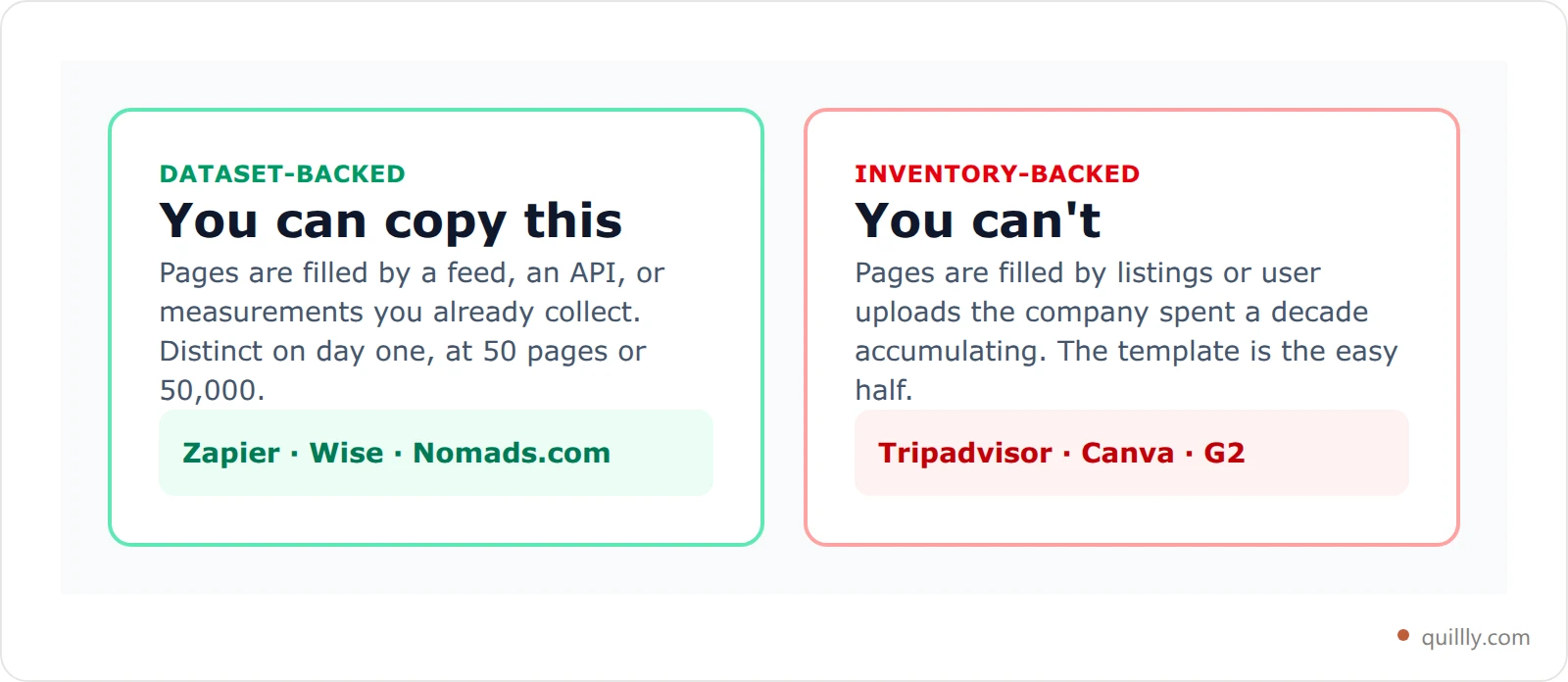
A programmatic SEO example is worth copying when each page's uniqueness comes from a dataset you already own — an API, a live feed, a measured number — not from re-worded prose. Zapier, Wise and Nomads.com all pass that test at any size. Tripadvisor and Canva pass it too, but only because their authority absorbs the volume.
So this isn't another gallery of traffic screenshots. It's a teardown of six real page sets, sorted by the one thing that decides whether you can copy them: where the per-page data comes from. Every example below was opened and checked, and the numbers from our own domain are pulled from this site's live search data.
On this page: What makes an example copyable · Zapier · Wise · Nomads.com · Our own tool pages · The uncopyable three · The copyability test · FAQ
What makes a programmatic SEO example copyable#
An example is copyable when the data filling each page comes from a source you can reproduce. Sort programmatic page templates by that source and they fall into two groups, and only one of them transfers to a site your size.
The first group builds pages on top of something structured that already exists: an API's list of endpoints, a rate feed, a table of measured metrics. The page writes itself because the data is genuinely different in every row. The other group builds pages on top of inventory — 75 million hotel listings, 100 million user-made templates — which is only reproducible if you already own the inventory.
Example | Template variable | Where the per-page data comes from | Copyable at low DR? |
|---|---|---|---|
Zapier | App A × App B | Each app's real trigger and action list | Yes — if you have an API |
Wise | Currency A → B | Live mid-market rate feed | Yes — if you have a feed |
Nomads.com | City | Community-submitted city metrics | Yes — slowly |
Our /tools/ pages | Tool function | The working tool on the page | Yes |
Tripadvisor | Place | 75M+ listing pages of inventory | No |
Canva | Design type | A template marketplace | No |
The right question isn't "how many pages did they get?" It's "what fills the middle of each page, and do I have anything like it?"
Example 1: Zapier app-pair pages#
The most-cited programmatic set on the web, and still the clearest to learn from.
Zapier publishes one page per pair of apps it connects — Slack + Google Sheets is one cell in a grid that runs to thousands of combinations. Open it and the body isn't marketing copy. It's an inventory: 13 Slack triggers, 30-plus Slack actions, 7 Google Sheets triggers, 30-plus Sheets actions, each with a one-line description and its input fields.
That matters more than the page count. The uniqueness comes straight out of Zapier's own integration catalog. Nobody wrote 5,000 descriptions of Slack; the catalog already knew what Slack could do, and the template renders it.
What to steal: the pairwise pattern. If your product touches N things — integrations, file formats, frameworks, currencies — you have N × (N−1) ÷ 2 potential pages, and each one is filled by the two halves you already documented. Twenty integrations is 190 pages, which is comfortably past the point where a template beats writing by hand.
Where it goes wrong: most people build the grid before checking that anyone searches the combinations. "Slack Google Sheets integration" is a real query with real volume. "Obscure Tool A + Obscure Tool B" is a page nobody will ever request. Validate the pattern on a handful of pairs first — our AI keyword research playbook covers how to size a pattern before you template it.
Example 2: Wise currency-pair pages#
Wise runs a page for every currency pair it supports. USD to EUR carries the H1 "US dollars to Euros exchange rate today", and the page is almost entirely numbers.
Checked live, that single page carries the mid-market rate, 30-day high, low and average, the same three for 90 days, the percentage change over both windows, an interactive chart with six timeframes, and a conversion table for twelve common amounts. None of it is written. All of it is a feed.
This is the cleanest illustration of a rule worth internalizing: the best programmatic pages have very little prose in them. Wise isn't trying to out-write a finance blog. It's answering a numeric question faster than anyone else, and the answer changes daily, which also solves freshness for free.
What to steal: the "live answer" template. If you can compute something — a conversion, a score, a comparison, a benchmark — the computation is your per-page uniqueness, and it updates itself without an editorial calendar.
Where it goes wrong: shipping the calculator with 300 words of filler wrapped around it to hit a word count. That filler is the part that reads as templated. Wise doesn't pad, and neither should you.
Both programmatic page templates so far share one property worth naming: the page is useful before a single sentence is written. If you want that standard enforced automatically on everything you publish, every draft here is scored before it can go live.
Example 3: Nomads.com city pages#
Nomads.com (formerly Nomad List) publishes one page per city at nomads.com/[city] — /bangkok, /london, /tbilisi.
Each city page shows cost of living for a remote worker, current and annual temperature with a monthly breakdown, air quality, humidity, a monthly UV index, internet speed, a safety score, how many members are there now, member ratings, likes and dislikes from both visitors and locals, and how often people come back. Hundreds of filters sit on top so the set doubles as a faceted search.
The interesting part is where the data comes from: members. The site didn't buy a dataset, it built a loop where the people using the pages supply the numbers that make the pages worth using.
What to steal: the accumulating dataset. You don't need all the rows on day one. A page set that gets more distinct every month is the rare kind that improves without an editor touching it.
Where it goes wrong: launching all 800 cities with three fields each while you wait for data to arrive. Ship 40 cities that are genuinely full instead. Thin-and-wide is the shape Google's spam policies describe as scaled content abuse; deep-and-narrow is just a good site.
Example 4: our own tool pages, with the numbers attached#
Here's the example you won't find in other lists, because it comes with the uncomfortable half.
This domain runs about 50 templated pages under /tools/ — a word counter, a color picker, a JSON formatter, a SERP preview, a keyword density checker and so on. Same shell, same layout, one working tool per page. Alongside them sit 138 published blog posts, each hand-written and SEO-scored.
The four highest-impression URLs on this domain are all tool pages:

Four templated pages out-earn the best of 138 hand-written posts on impressions. That's the argument for programmatic SEO in one chart, and it's real.
Now the uncomfortable half. Those tool pages sit at average positions of 23, 9, 30 and 21, and across the whole domain we recorded 8,540 impressions and 17 clicks over the 90 days ending 3 September 2026 — a 0.2% click-through rate at an average position of 38.9. The tool pages are being shown. They're mostly not being clicked, because position 23 is page three.
That's the honest version of a programmatic SEO example. A template gets you into the index and in front of queries far faster than writing does. It does not get you to the top of page one, and impressions aren't traffic. If you want the same per-page, per-engine numbers for your own domain instead of a vendor's screenshot, connect your site and read them directly.
Three examples you can't copy, and why they're in every list#
Tripadvisor, Canva and G2 turn up in nearly every roundup of programmatic SEO examples. They're real, and they're the wrong lesson.
Tripadvisor's page set runs to tens of millions of URLs because it has tens of millions of listings, reviews and photos to hang them on. Canva's template pages are backed by a marketplace of user-created designs. G2's comparison grid is filled by verified software reviews it spent years collecting. In all three, the template is the easy part; the moat is the inventory underneath, and the authority that convinces engines to crawl millions of near-identical URLs in the first place.
There's a mechanical reason this doesn't transfer. Google's large-site crawl budget guidance is explicit that low-value URLs eat the crawl allowance your good pages need. A DR 500 domain has room to spend. A DR 12 domain doesn't — and ours is DR 12, so this isn't a hypothetical.

Three engines, three different answers about the same 138 pages: Yandex keeps 93% of them, Google 55%, Bing 21%. Scale that spread across a 5,000-page run and the "5,000 pages" number stops meaning anything. It's also why we treat coverage as a multi-engine problem rather than a Google-only one — Bing is the strictest gate we measure, and it's the one feeding ChatGPT's citations.
The four-question copyability test#
Run any example you're about to imitate through these, in order. The first "no" tells you what to fix instead of what to build.
What fills the middle of the page? If the answer is "AI-written paragraphs about the row", stop. If it's an API response, a feed, a measurement or a working tool, keep going.
Do I already own that data, or can I compute it? Zapier owned its catalog. Wise owns a rate feed. Nomads.com grew one. Buying a generic dataset everyone else can buy produces pages everyone else can produce.
Does anyone search the pattern? Check volume on five or six real combinations before templating hundreds. Most abandoned pSEO projects die here, after the build.
Can my domain absorb the volume? If your current index rate is under 60%, adding pages lowers it. Fix links and submission first.
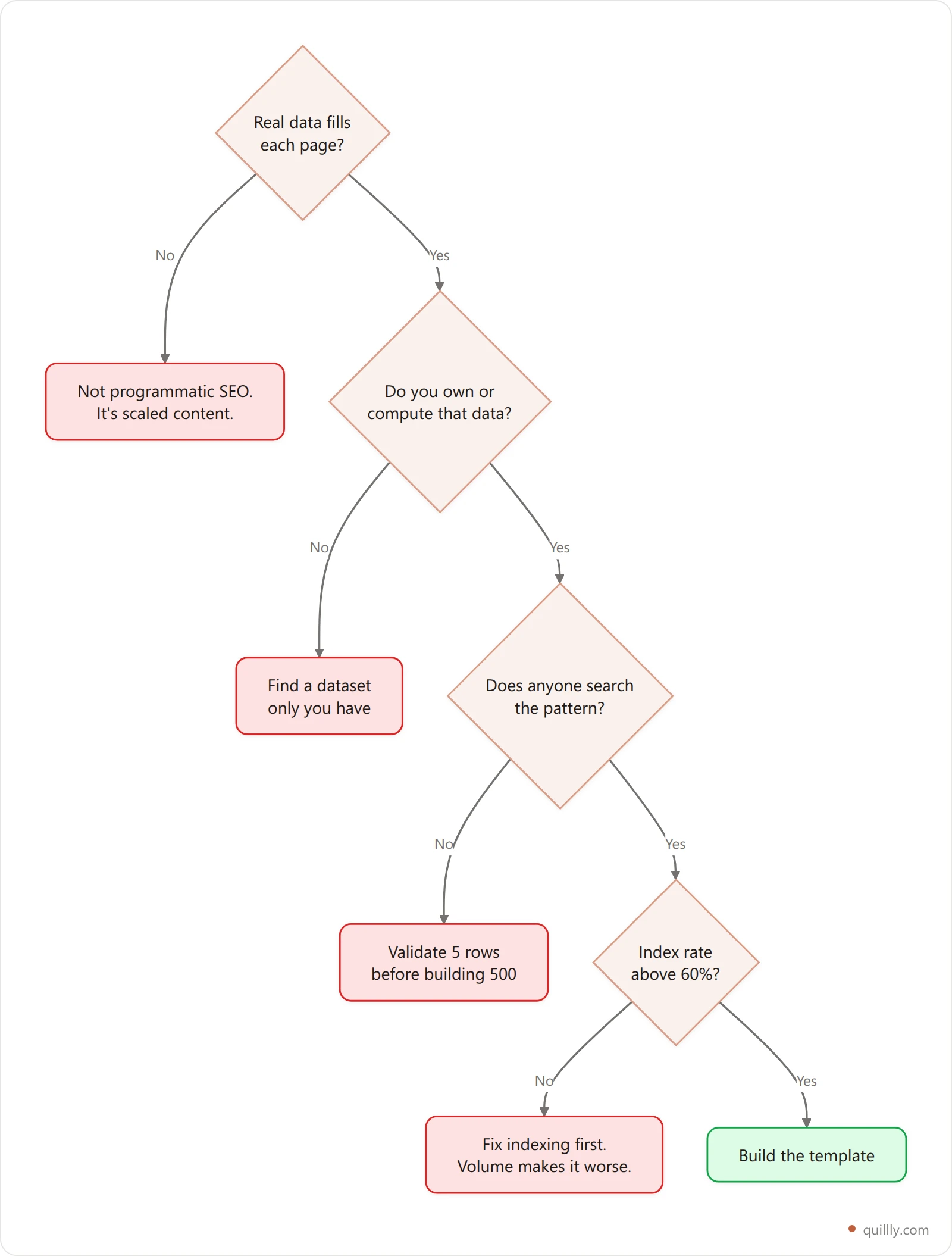
Question four is the one that gets skipped, and it's the one that decides whether the other three mattered. We broke the whole pipeline down in what programmatic SEO tools actually automate — the short version is that generation is the cheap layer now, and indexing is the layer nobody sells.
Check your index rate before you scale
Scaled content indexing decides what a programmatic run is actually worth. Quillly reports it per page and per engine for Google, Bing and Yandex, so you can see which pages were kept and which were quietly dropped.
Start a 14-day trialWhat to do the week after you publish them#
A programmatic set has a discovery problem that a single blog post doesn't. Five hundred URLs appear at once, with no inbound links, on a domain that may only be crawled every few days.
Three things move the needle, in this order:
Internal links from pages already in the index. Point them at the new set from your existing content, not just from a hub page that's also brand new. It's the single most reliable lever we've measured.
Direct submission, not just a sitemap. A sitemap gets read when the crawler decides to read it. IndexNow pings Bing, Yandex, Naver, Seznam, Yep and Amazon immediately, with Yahoo following Bing. Google doesn't take part, so it needs its own path — an updated sitemap and RSS feed through Search Console.
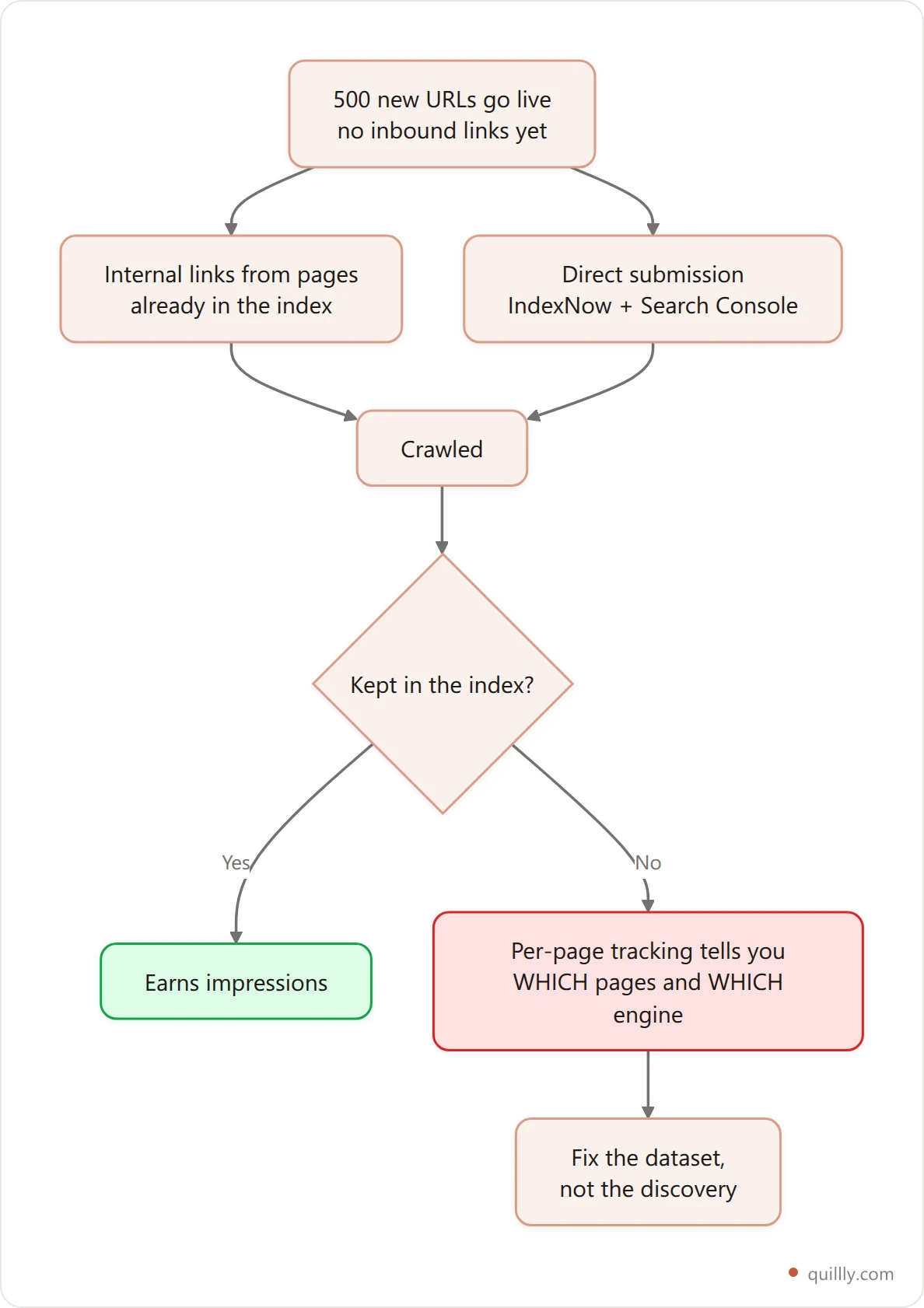
Per-page index tracking. Without it you can't tell a dataset problem from a discovery problem, and you'll spend months fixing the wrong one. Tracking pages you generated elsewhere works the same way, through your sitemap.
Quillly handles the last two for content it publishes: every publish and update pushes a fresh sitemap and RSS feed to Google, notifies the IndexNow network, and reports back per page and per engine on whether Google, Bing and Yandex kept the page. Every item is also scored against 14+ SEO criteria before it can ship, which is a blunt but effective guard against publishing 500 thin pages and finding out in December. Pricing starts at $9/month after a 14-day trial with no card. See what a real index rate looks like on your domain.
Frequently Asked Questions#
What is the best programmatic SEO example to learn from?#
Zapier's app-pair pages, because the data source is visible. Open any integration page and you can see the triggers and actions coming straight out of the product catalog. It makes the core principle obvious: the template renders data you already have, it doesn't invent content to fill a shape.
How many pages does a programmatic SEO project need?#
Around 200 rows is the practical floor. Below that, building a template, a data pipeline and a QA pass costs more than writing the pages. Above it, per-page cost drops quickly — as long as your index rate holds, which is the constraint most people meet only after paying.
Are programmatic SEO examples still working in 2026?#
The dataset-backed ones are. Wise, Zapier and Nomads.com pages still rank because each one answers a distinct query with distinct data. What stopped working is the thin variant — one variable swapped across hundreds of otherwise identical pages, which engines now decline to index rather than rank badly.
Can a new site with low domain authority do programmatic SEO?#
Yes, at a smaller scale, and results come slower. Our own tool pages are the four biggest impression earners on a DR 12 domain. But they sit at average positions between 9 and 30, so treat programmatic pages as a way to enter many queries cheaply, not as a traffic switch.
What's the difference between programmatic SEO and scaled content abuse?#
The data underneath each page. A template that fills every page with genuinely different facts is programmatic SEO. A template that re-words the same page hundreds of times is what Google's spam policies describe, whether a human or a model produced the words. The generation method isn't what's judged.
How do I know if my programmatic pages got indexed?#
Check per page and per engine, not in aggregate. A page can be live in Yandex and absent from Google, which looks like "indexed" in a cross-engine summary and earns nothing where it counts. Search Console covers Google; IndexNow-network engines report separately.
Key takeaways#
Sort examples by data source, not by traffic. Feed-backed and API-backed sets are copyable; inventory-backed ones aren't.
The best programmatic pages barely have prose. Wise's currency pages are almost entirely numbers, and that's the point.
Datasets can accumulate. Nomads.com built its city metrics from members over years rather than buying them.
Impressions aren't traffic. Our four tool pages beat 138 posts on impressions while averaging positions 9 to 30.
Index rate is the multiplier. At 55% on Google and 21% on Bing, half a programmatic run is invisible before anyone judges the writing.
Judge programmatic SEO examples by one thing — whether you can reproduce the data source — then validate five rows before you build five hundred, and check your index rate before you scale anything. That order costs nothing and saves the three months most programmatic projects lose.


