
First-Party Data AI Content Creation: The Small Business Advantage#
Artificial intelligence is no longer a futuristic buzzword for small businesses—it’s a proven profit engine. A recent study shows that SMBs that integrate AI into their content workflows see an average ROI of 1,200 % within the first year 100+ AI Marketing Statistics for 2026 – NewMedia. The secret sauce? First-party data combined with AI content creation — a strategy that gives small businesses a uniquely competitive edge no competitor can copy.
First‑party data—information you collect directly from customers through your website, POS, email, or surveys—gives you a trustworthy, unique view of your audience that third‑party cookies simply can’t match. When you pair that data with generative AI, you can produce hyper‑personalized blogs, FAQs, video scripts, and more—without hiring a full‑time copy team.
In this guide you’ll get a step‑by‑step workflow that walks you from data collection to publishing AI‑generated assets that rank in AI overviews and zero‑click answers. We’ll also recommend low‑cost tools (many under $80 per user per month) and provide downloadable templates so you can start today, even on a shoestring budget.
Why First-Party Data Is the Foundation of Effective AI Content Creation #
Trust and Uniqueness #
Trust – First‑party data is collected with explicit consent, so AI models can safely use it without privacy penalties.
Uniqueness – No other brand has your exact purchase history, email interactions, or survey insights, giving your content a competitive edge.
Boosting Citations in AI Search Overviews #
Research shows that content built on original research and first‑party data is cited 2‑5× more often in AI‑generated search overviews 100+ AI Marketing Statistics for 2026 – NewMedia. Those citations translate directly into zero‑click visibility, the most coveted real‑estate on today’s SERPs.
If you want a deeper dive on how proprietary data fuels AI‑generated rankings, check out our guide on AI Generated Original Data for Content: A Small Business Guide to Ranking in AI Overviews (2026). According to Google's Search Quality Evaluator Guidelines, original first-party data is one of the strongest E-E-A-T signals a site can produce.
The Missing Playbook #
Despite the upside, 40 %‑70 % of marketers rely on self‑taught habits because they lack a shared playbook 100+ AI Marketing Statistics for 2026 – NewMedia. This guide fills that gap with a repeatable, budget‑friendly process tailored for small businesses.
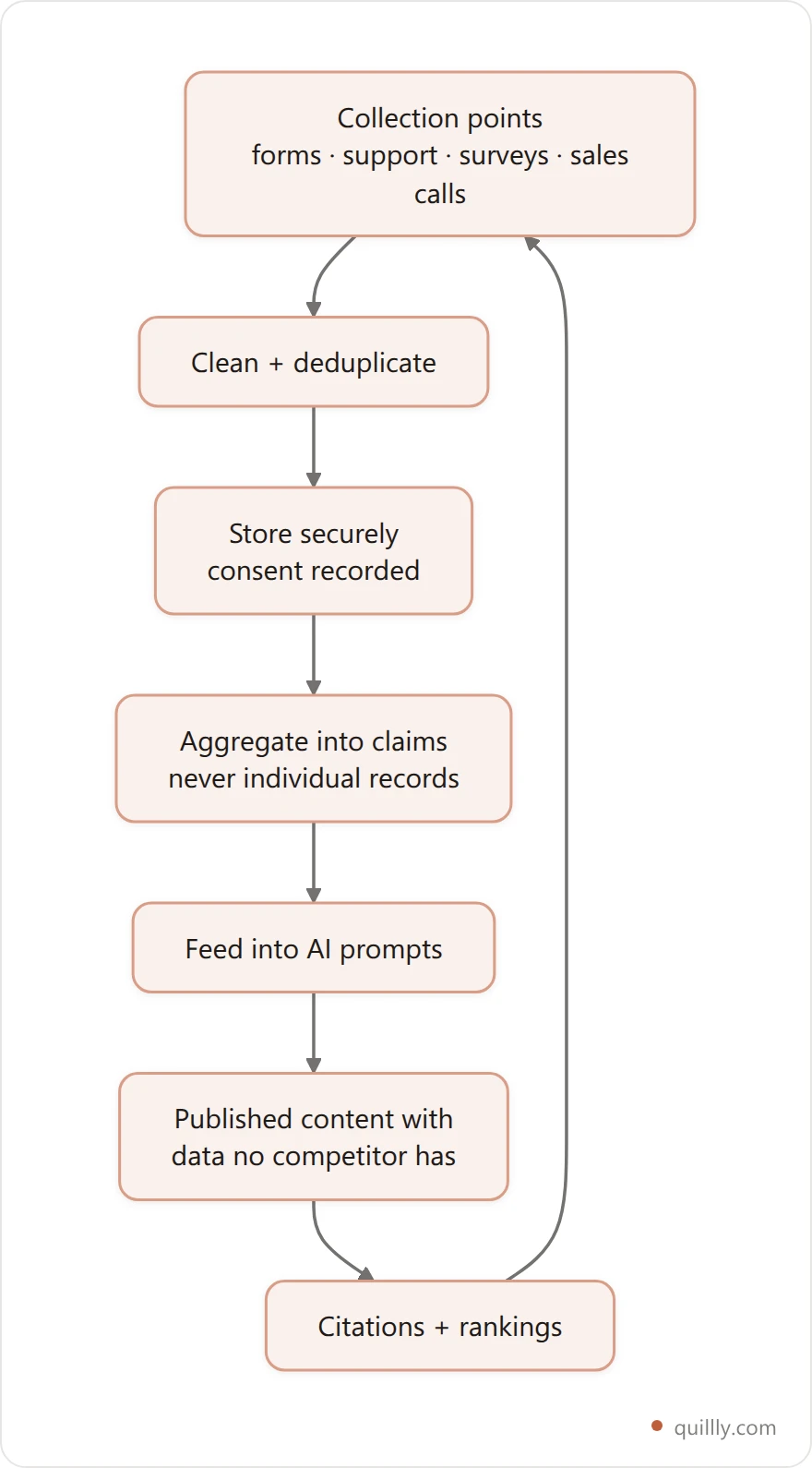
Building a Budget‑Friendly First‑Party Data Stack #
1. Choose Free or Low‑Cost CDP Alternatives #
Tool | Cost | Key Feature |
|---|---|---|
Google Analytics 4 | Free | Event‑level tracking, audience segmentation |
HubSpot CRM (Free tier) | Free | Contact management, email capture |
Metabase | Open‑source | Simple dashboards for data hygiene |
Segment (Starter) | $0‑$20/mo | Data routing to multiple destinations |
These solutions give you a Customer Data Platform (CDP)‑like foundation without the enterprise price tag.
2. Collect Data Where You Already Interact #
Surveys & Feedback Forms – Embed short polls after checkout or in email newsletters.
Point‑of‑Sale (POS) Systems – Export transaction logs weekly.
Email Marketing Platforms – Pull open‑rate, click‑through, and segmentation data.
3. Data Hygiene: The “Clean‑Room” for SMBs #
Deduplication – Use spreadsheet formulas or Metabase “distinct” queries.
Normalization – Standardize date formats, country codes, and product SKUs.
GDPR / CCPA Compliance – Flag consent fields, enable easy opt‑out mechanisms.
Downloadable resource: First‑Party Data Audit Checklist (available in the sidebar after you scroll).
4. Store Securely #
A simple Google Cloud Storage bucket with bucket‑level IAM policies is enough for most SMBs. For added security, consider a clean‑room layer using tools like Snowflake’s Secure Data Sharing (free tier available for under 1 TB).
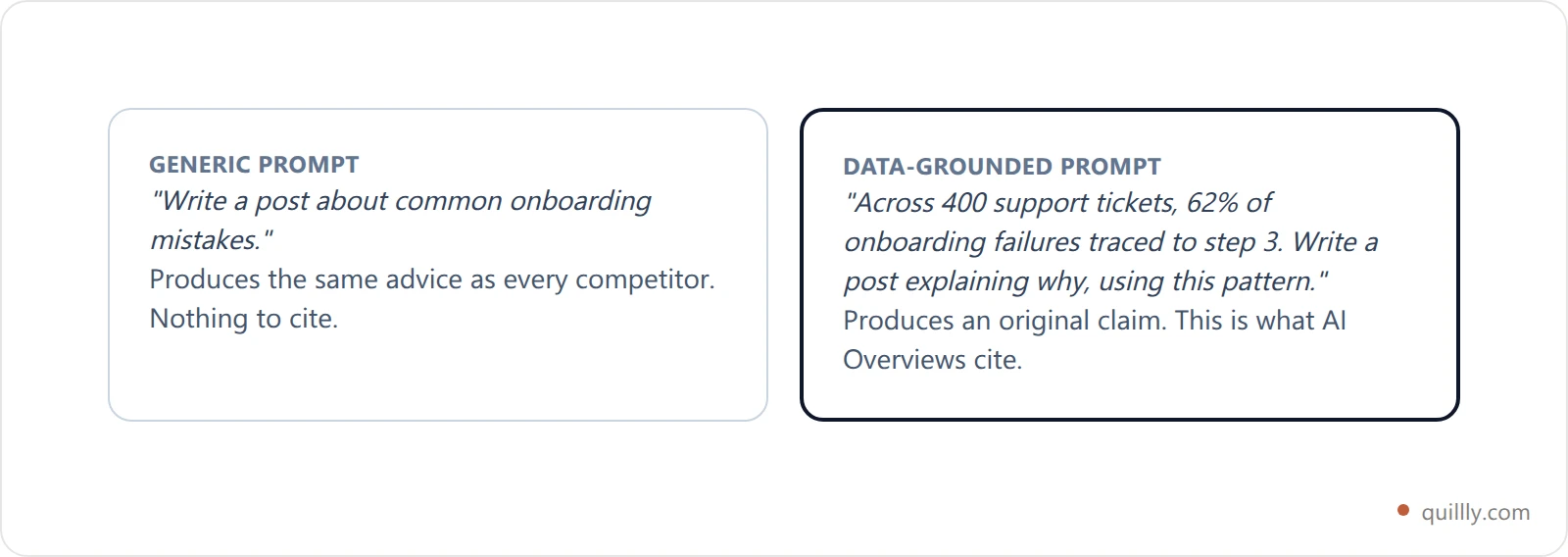
Crafting AI‑Ready Prompts from Your Data #
Prompt Engineering Basics #
Be Specific – “Write a 800‑word blog about “eco‑friendly packaging trends” using our 2025 sales data (average order value $45, top regions: UK, Germany).”
Provide Context – Include a short data snippet or CSV excerpt in the prompt.
Define Output Format – “Return a markdown file with H2 headings, bullet points, and a meta description under 160 characters.”
Prompt Templates for SMBs #
Content Type | Prompt Template |
|---|---|
Blog Post |
|
FAQ |
|
Video Script |
|
Tuning Period #
Most teams see measurable efficiency gains after 4‑8 weeks of consistent prompting and workflow tuning 100+ AI Marketing Statistics for 2026 – NewMedia. Use that window to refine prompts, add new data sources, and track output quality.
Publishing AI‑Generated Assets that Rank in AI Overviews and Zero‑Click Answers #
SEO‑Ready Structure #
Topic Clusters – Create a pillar page (e.g., “Sustainable Packaging”) and link to AI‑generated sub‑articles (e.g., “Biodegradable Materials”).
Internal Linking – Use AI to suggest anchor text that matches target keywords.
Schema Markup – Add
Article,FAQPage, andVideoObjectschema to improve SERP features.
According to industry data, 40‑65 % of marketers already use AI for SEO tasks such as topic clustering and internal linking 100+ AI Marketing Statistics for 2026 – NewMedia.
Targeting Zero‑Click Opportunities #
Identify “People Also Ask” (PAA) questions with tools like AnswerThePublic (free tier).
Generate concise, data‑backed answers (under 300 characters) and embed them in FAQ schema.
Read more about winning zero-click visibility in our post on Zero-Click Search 2026: How Small Businesses Can Win Visibility in AI-Driven Answers.
Affordable SEO Validation Tools #
Tool | Monthly Cost | What It Does |
|---|---|---|
Surfer SEO | $29 | Content score, keyword density, SERP analysis |
Clearscope | $39 | Topic relevance, semantic keyword suggestions |
Ubersuggest (Free tier) | $0 | Site audit, backlink overview |
Integrate these tools into your publishing pipeline to ensure every AI‑generated piece meets ranking standards before it goes live.
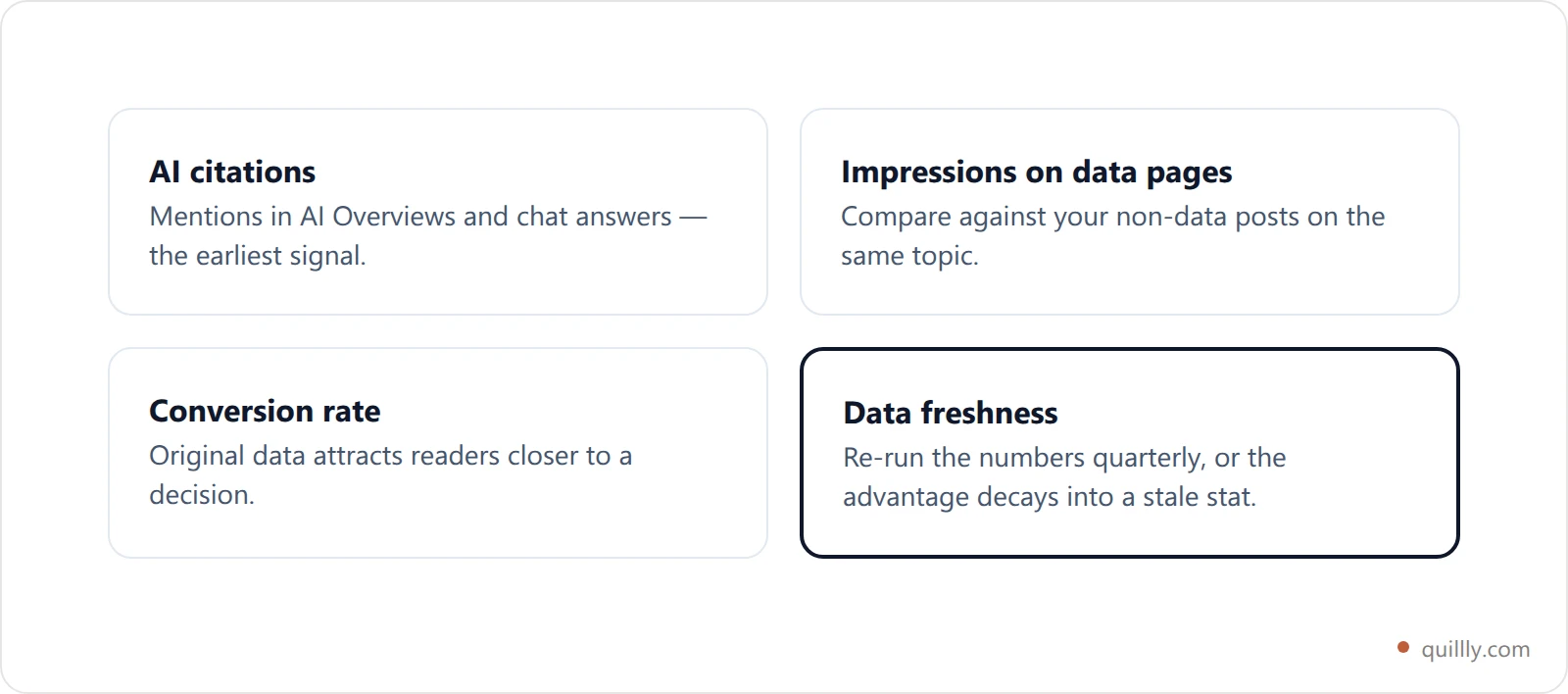
Measuring ROI and Scaling the Workflow #
ROI Calculator Template #
Download our ROI Calculator (Excel) and input:
Metric | Example (Belfast Consultancy) |
|---|---|
Monthly AI tool spend | $120 (ChatGPT Plus, Canva, Copy.ai) |
Revenue lift | $2,300 |
Payback period | 2.3 weeks |
ROI | 1,893 % How Small Businesses Achieve 200 Percent ROI with AI |
Similar results were reported by a skincare e‑commerce brand (926 % ROI) How Small Businesses Achieve 200 Percent ROI with AI and a small accountancy practice (1,446 % ROI) How Small Businesses Achieve 200 Percent ROI with AI.
Scaling Roadmap #
Add More Data Sources – Integrate loyalty program data, social listening, and CRM notes.
Automate Prompt Generation – Use Zapier to trigger prompts when new rows appear in Google Sheets.
Batch Publishing – Schedule AI‑generated content in WordPress via the WP All Import plugin (free for 10 k rows).
Continuous Optimization – Review performance dashboards weekly; adjust prompts based on click‑through and dwell time metrics.
Case Study Highlights #
Business | Staff | Tools Used | ROI |
|---|---|---|---|
Belfast consultancy | 4 | ChatGPT Plus, Canva, Copy.ai | 1,893 % |
Skincare brand | 3 | ChatGPT Plus, Tidio, Copy.ai, Canva | 926 % |
Accountancy practice | 6 | ChatGPT, Otter.ai, Zapier | 1,446 % |
These examples prove that first‑party data AI content creation can deliver outsized returns even for teams of fewer than ten people.
Frequently Asked Questions#
What counts as first-party data for a small business?#
Anything you collect directly: form submissions, support tickets, survey responses, purchase history, sales call notes, and on-site behaviour. You almost certainly have more than you think — most small businesses are sitting on years of support tickets nobody has ever aggregated.
Why does first-party data help content rank in AI search?#
Because it produces claims that exist nowhere else. AI engines preferentially cite specific, verifiable, original numbers over restated general advice. A statistic drawn from your own 400 support tickets cannot be sourced from a competitor's page.
Do you need a customer data platform to start?#
No. A spreadsheet and a clear question will do for the first cycle. CDPs solve scale and activation problems you do not have yet, and buying one before you have a repeatable question to ask is the most common way this stalls.
Is it safe to put customer data into AI prompts?#
Only in aggregate. Feed patterns and percentages, never individual records or anything personally identifying. Aggregate first, then prompt — that keeps the insight intact while removing the risk, and it also produces better writing.
How often should you refresh your data claims?#
Quarterly for anything you present as current. A stat with a stale date reads as neglect and gets replaced in AI answers by whoever published more recently. Refreshing is cheap once the collection pipeline exists.
Conclusion #
You now have a complete, budget‑friendly workflow:
Collect clean first‑party data with free CDP alternatives.
Hygiene the data to meet GDPR and ensure accuracy.
Engineer prompts that turn raw numbers into compelling AI‑generated content.
Publish using SEO‑ready structures that target AI overviews and zero‑click answers.
Measure ROI with our calculator and scale through automation.
Ready to put the plan into action? Download the template bundle (audit checklist, prompt library, ROI calculator) from the sidebar, explore our AI-Ready Website 2026 guide for technical SEO foundations, and start a free 14-day Quillly trial — AI content generation, brand voice training, SEO scoring, and direct publishing on your domain, all in one platform.
Your first‑party data is the gold mine; AI is the excavator. Combine them, and watch your content assets multiply.