---
title: Markdown for AI Crawlers: The .md Twin Guide (2026)
description: AI crawlers can't run your JavaScript and ignore llms.txt. Here's the markdown twin method that gets ChatGPT, Claude, and Perplexity to read and cite you.
keywords: markdown for AI crawlers, serve markdown to AI crawlers, md twin, llms.txt vs markdown, content negotiation AI crawlers
published: 2026-07-22
updated: 2026-07-22
url: https://quillly.com/blogs/markdown-for-ai-crawlers
word_count: 2877
---
## Related Pages
- [019e1ec6-084f-71c0-98d8-99da870a7f27](https://quillly.com/blogs019e1ec6-084f-71c0-98d8-99da870a7f27)
- [019e7656-caf3-75ae-a011-f5dad5a82469](https://quillly.com/blogs019e7656-caf3-75ae-a011-f5dad5a82469)
- [019f7b3e-32b2-7237-b22f-63c685d54353](https://quillly.com/blogs019f7b3e-32b2-7237-b22f-63c685d54353)
- [019eb944-0714-72e0-bab3-89fc70e458c7](https://quillly.com/blogs019eb944-0714-72e0-bab3-89fc70e458c7)
- [019f0683-9b34-70c3-a758-926ffae22264](https://quillly.com/blogs019f0683-9b34-70c3-a758-926ffae22264)
- [019f77d3-bcb5-743e-be4a-332d6bb82f9d](https://quillly.com/blogs019f77d3-bcb5-743e-be4a-332d6bb82f9d)
- [019f5e12-db3a-7446-ba94-51b28e125e43](https://quillly.com/blogs019f5e12-db3a-7446-ba94-51b28e125e43)
*Photo by [Mohammad Rahmani](https://unsplash.com/@afgprogrammer?utm_source=quillly&utm_medium=referral) on [Unsplash](https://unsplash.com?utm_source=quillly&utm_medium=referral)*
*Updated July 2026.*
Open your blog, disable JavaScript in your browser, and reload. If the page goes blank, that blank page is roughly what ChatGPT sees when it visits. Most AI crawlers make one plain HTTP request and read whatever HTML comes back. They don't wait for React to hydrate. So the content you worked hard on can be invisible to the exact systems now sending referral traffic and citations. Markdown for AI crawlers fixes this by handing bots a clean, chrome-free version of each page instead of your rendered app.
And the fix most people reach for first, llms.txt, barely moves the needle: Ahrefs analyzed 137,000 domains and found 97% of llms.txt files got zero requests in May 2026. Meanwhile GPTBot's crawl volume grew 305% year over year, per Cloudflare. The demand is real. The plumbing is wrong.
**Markdown for AI crawlers means serving a clean, chrome-free **`**.md**`** version of each page that bots read instead of your JavaScript-heavy HTML.** AI crawlers rarely execute JavaScript, so a per-page markdown twin at its own URL is the most reliable way to get ChatGPT, Claude, and Perplexity to read and cite your content accurately.
This guide covers why bots choke on modern HTML, why llms.txt underdelivers, and the markdown twin method that actually works.
## What "markdown for AI crawlers" actually means
Markdown for AI crawlers is the practice of publishing a plain-text, markdown version of a page for machines, while humans still get the styled HTML page. The markdown drops your nav, sidebar, cookie banner, ads, and script tags. What's left is the stuff that matters: the heading, the prose, the tables, the links, and the sources.
This matters because retrieval systems tokenize whatever they fetch. A markdown document is almost pure signal, so more of your actual content survives the crawler's budget and lands in the model's context window. A bloated HTML page spends most of that budget on markup and boilerplate the model then has to ignore.
Think of it as two doors to the same room. Humans walk through the HTML door. Bots walk through the markdown door. Same content, two representations, one canonical page. Get both doors right and you stop leaving citations on the table.
## Why AI crawlers choke on your HTML
The core problem is simple: most AI crawlers don't run JavaScript. Googlebot renders pages with a headless Chromium and indexes the post-render DOM. [GPTBot, ClaudeBot, and PerplexityBot](/ai-crawler-optimization-2026), plus OpenAI's OAI-SearchBot, generally do not. They read the raw HTML response and stop. If your blog is client-side rendered, the bot receives an empty `<div id="root"></div>` where your article should be.
Even when your content is server-rendered, the bot still wades through navigation, related-post widgets, comment forms, and analytics scripts to find the 1,200 words that matter. That's wasted crawl budget and diluted signal.
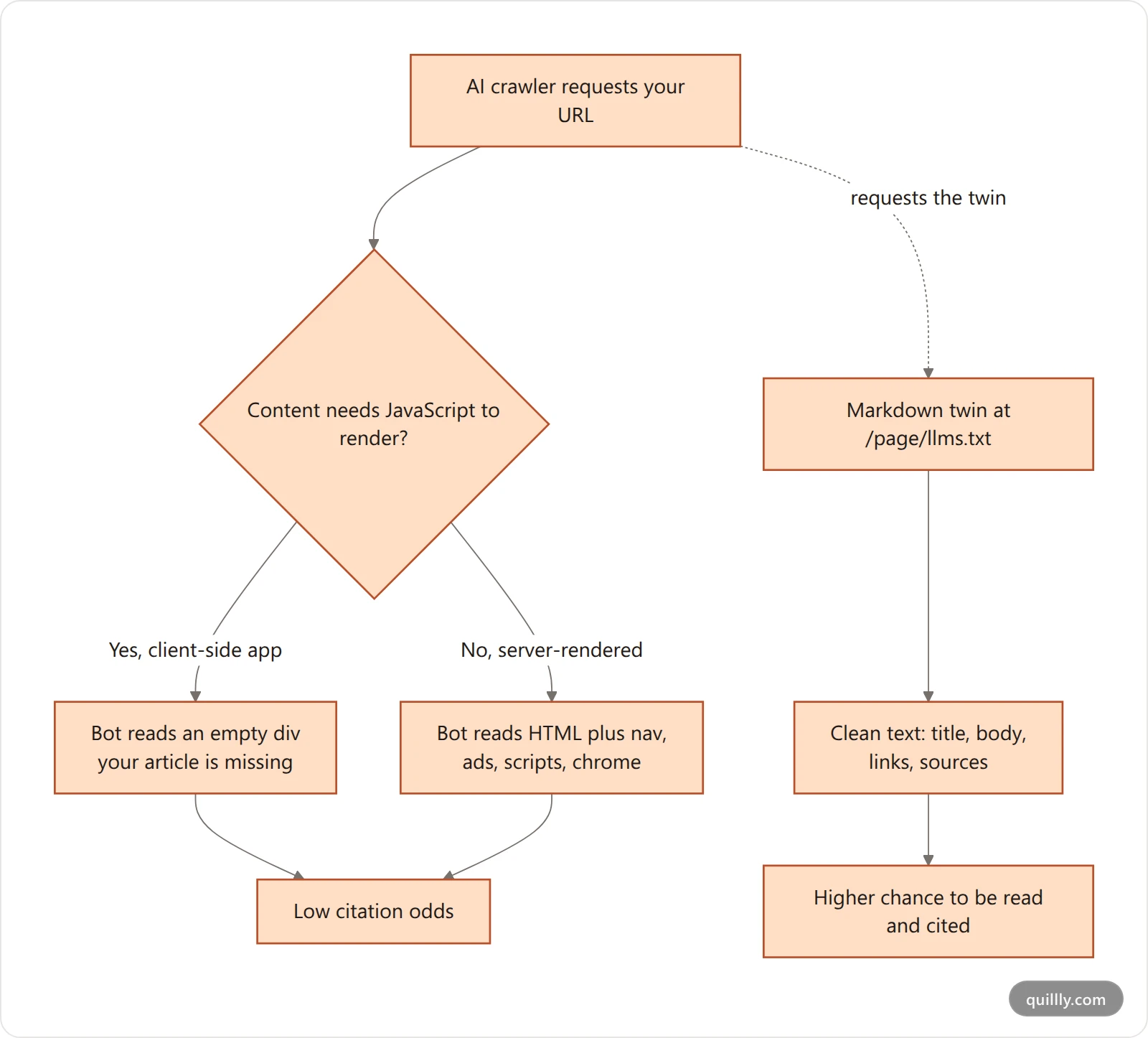
*How AI crawlers experience a normal page versus a markdown twin*
Here's which crawlers you're actually writing for, and whether they render JavaScript:
| Crawler | Operator | Runs JavaScript? | Purpose |
| --- | --- | --- | --- |
| Googlebot | Google | Yes | Search + AI Overviews |
| GPTBot | OpenAI | No | Model training |
| OAI-SearchBot | OpenAI | No | ChatGPT search index |
| ChatGPT-User | OpenAI | No | Live fetch during a chat |
| ClaudeBot | Anthropic | No | Training + retrieval |
| PerplexityBot | Perplexity | No | Answer engine index |
The takeaway: everything except Googlebot sees your raw HTML. If your content isn't in that first response as readable text, it may as well not exist to them.
## The llms.txt reality check
Everyone's rushing to publish llms.txt, but the data says it's not the win it was sold as. [llms.txt](/llms-txt-explained) is a curated markdown index at your site root that lists your important pages for LLMs. Nice idea. In practice, almost nothing reads it. Ahrefs' study of 137,000 domains found 97% of llms.txt files received zero requests, and only 28% of sites had published one at all. The requests that did land came mostly from SEO audit tools, not AI answer engines.
Google's John Mueller has been blunt about it, comparing llms.txt to the old keywords meta tag: *"It's basically you're telling these systems, like, I have the best website ever."* No major AI system uses it as a ranking or selection input today.
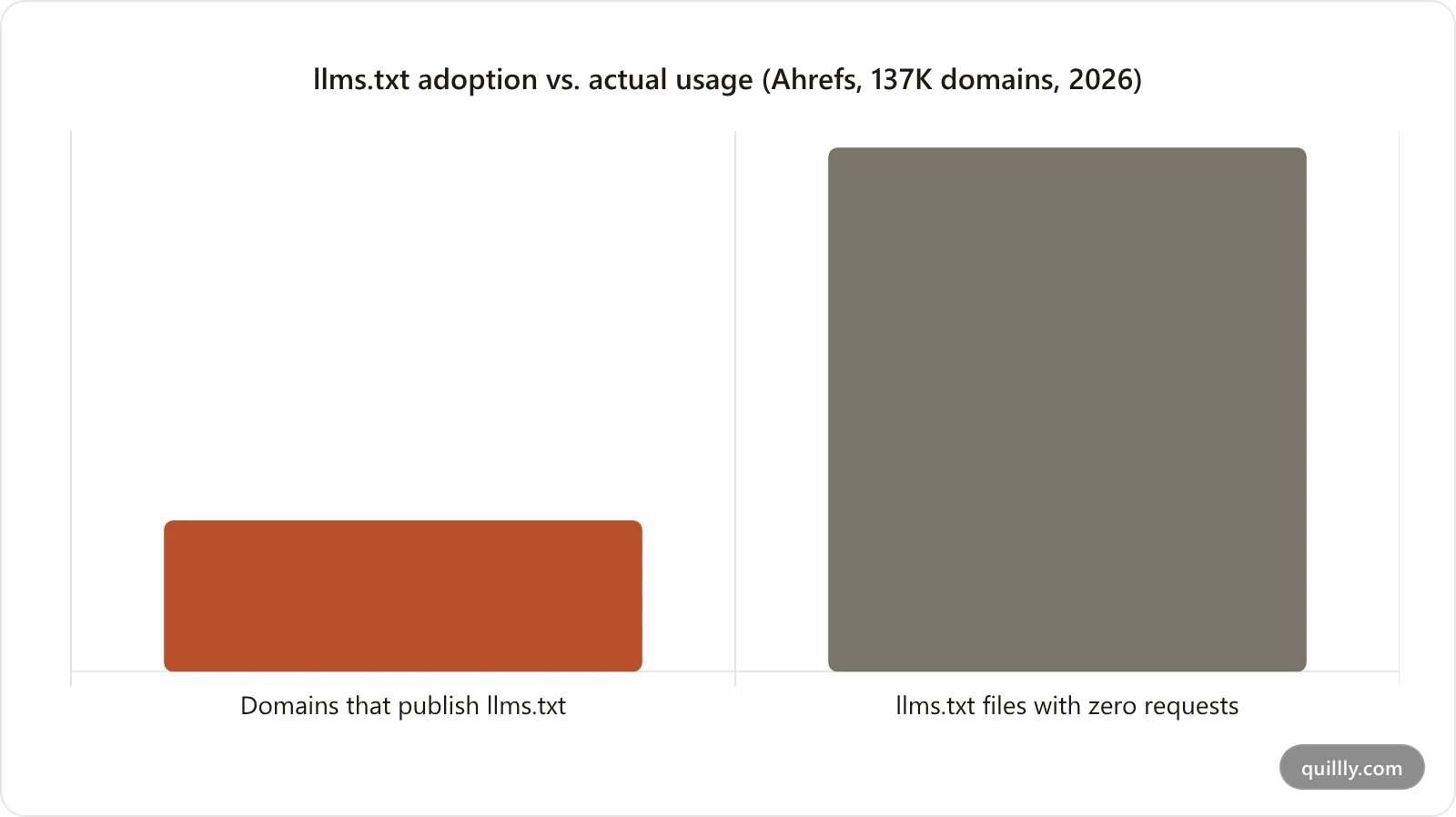
*llms.txt is widely misunderstood: publishing it is not the same as being read*
This doesn't make markdown useless. It makes a *root index file* useless on its own. The thing AI crawlers actually fetch is a markdown document that lives at the URL they already know about. That distinction is the whole game, and it's what the twin method gets right.
## The Markdown Twin Method
The Markdown Twin Method is a four-step setup that gives every page a machine-readable sibling without touching your rankings. It fixes the two failures above: no JavaScript wall, and no reliance on a root file nothing requests. Each step maps to something a crawler can actually discover and fetch.
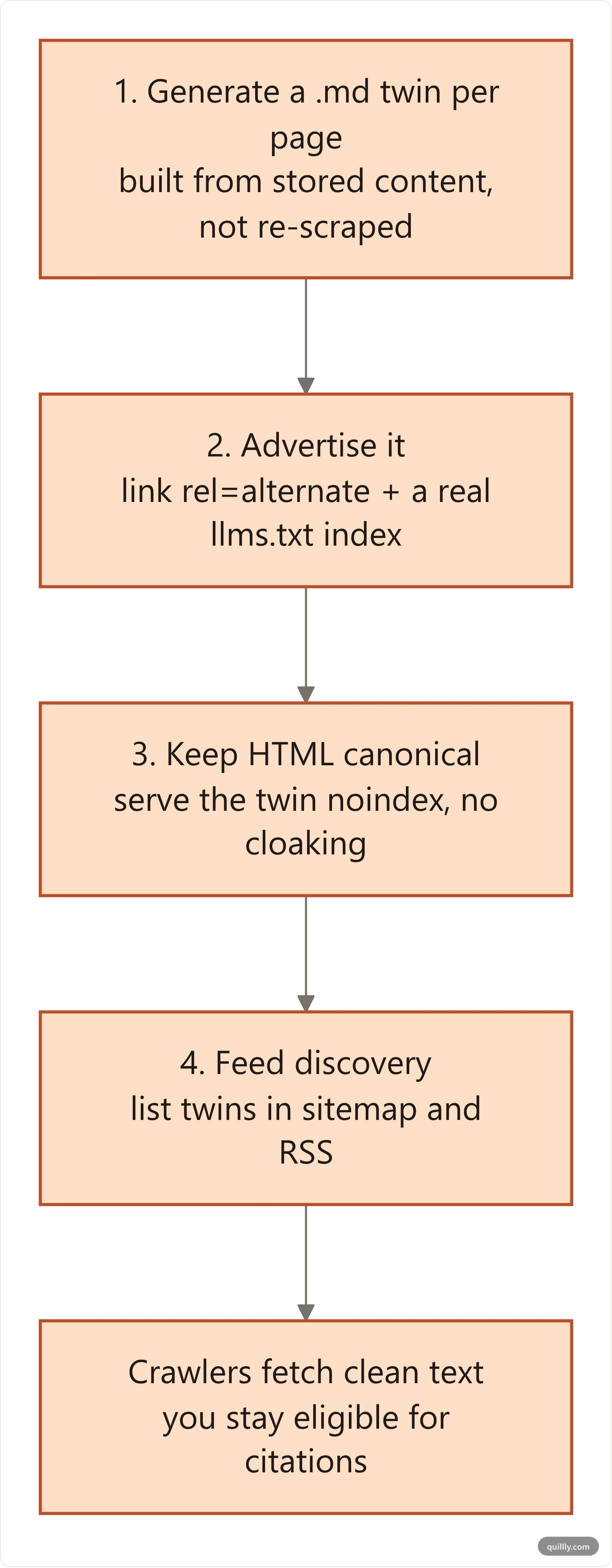
*The Markdown Twin Method, step by step*
1. **Generate a twin per page.** Build a `.md` document from your stored content so it can never drift from what the page shows. Include a small frontmatter block (title, description, canonical URL, dates) plus the body.
2. **Advertise it.** Add a `<link rel="alternate" type="text/markdown">` tag on the HTML page and list the twin in a real llms.txt index so agents that do look have a map.
3. **Keep HTML canonical.** The styled page stays the one search engines rank. Serve the twin `noindex` so you're adding a machine surface, not cloaking or duplicating.
4. **Feed discovery.** Put the twin URLs in your sitemap and RSS so crawlers find them the same way they find everything else.
Name it, use it as a checklist, and you've covered every path a bot might take to your content.
## Markdown twin vs llms.txt vs content negotiation
These three approaches get lumped together, but only one reliably gets fetched. A markdown twin is a dedicated URL per page. llms.txt is a single site-level index. Content negotiation means serving markdown when a request carries an `Accept: text/markdown` header. The catch: almost no AI crawler sends that header today, so negotiation alone reaches nobody. Dedicated URLs win because they're real, linkable, and discoverable through channels crawlers already use.
| Approach | What it is | Gets fetched by AI crawlers? | Effort | Verdict |
| --- | --- | --- | --- | --- |
| Markdown twin (dedicated URL) | A `.md` version of each page | Yes, when advertised + in sitemap | Medium | Do this |
| llms.txt (root index) | One markdown list of key pages | Rarely (97% get zero requests) | Low | Nice-to-have index |
| Content negotiation | Markdown via `Accept` header | Almost never (crawlers don't send it) | Medium | Bonus, not a strategy |
The smart setup uses all three as layers: dedicated twins do the heavy lifting, an llms.txt index acts as a map for the agents that read it, and content negotiation quietly serves markdown to the rare well-behaved client that asks. Lead with twins. Treat the rest as backup.
## How to build a markdown twin for every page
The mechanics are straightforward, and you should automate them so every new post ships with a twin. Start by generating markdown from your stored content, not by re-scraping the rendered page. Re-scraping reintroduces the exact HTML noise you're trying to escape.
Give each twin a discoverable URL. A common pattern is appending a suffix to the page URL:
```
https://yourdomain.com/blogs/your-post → HTML for humans
https://yourdomain.com/blogs/your-post/llms.txt → markdown for machines
```
Then advertise it in the HTML `<head>` so agents can auto-discover the twin:
```html
<link rel="alternate" type="text/markdown" href="/blogs/your-post/llms.txt" />
```
Keep the twin lean but self-describing. A good twin leads with frontmatter, then the body, then the sources it cites:
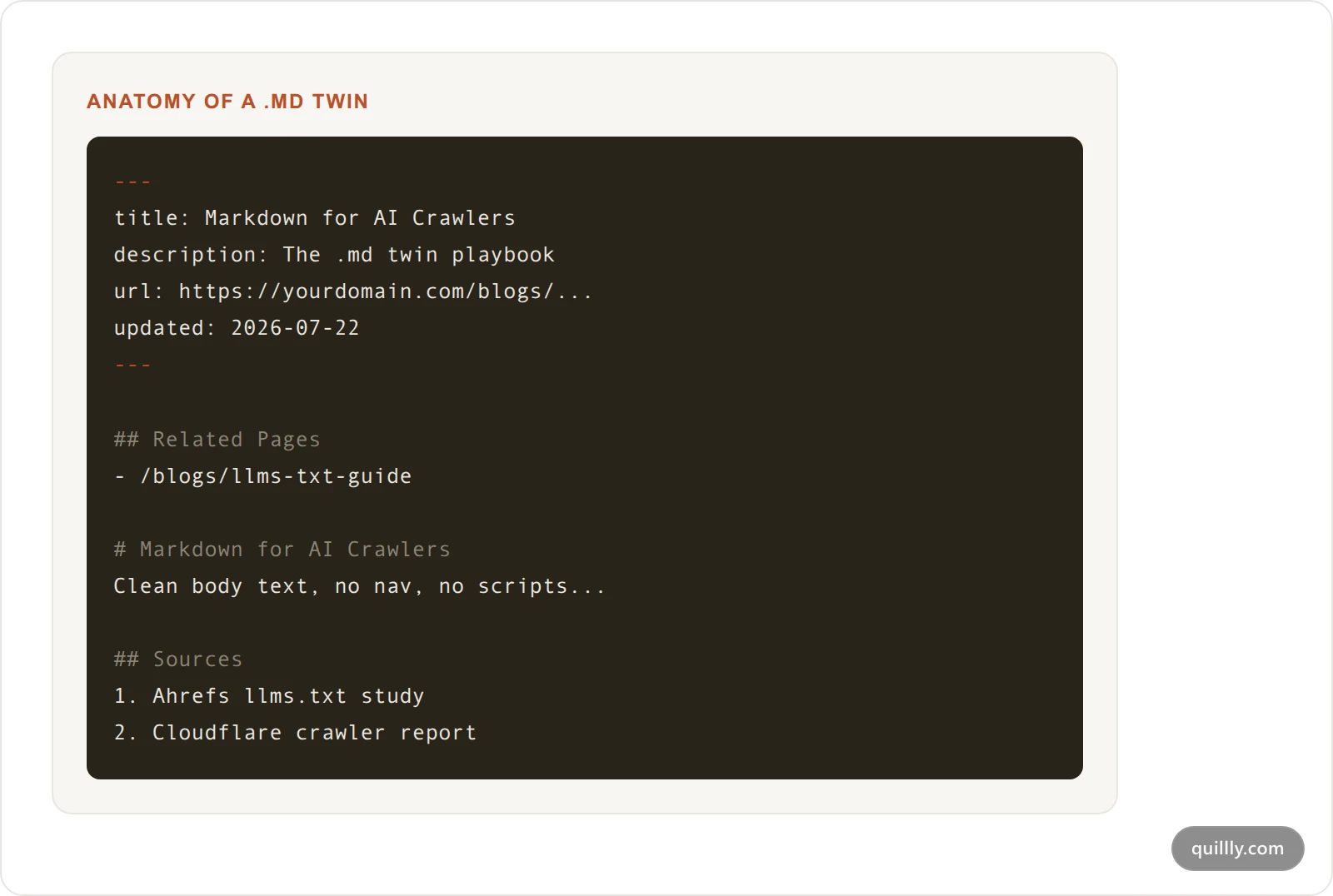
*A twin is pure signal: frontmatter, related links, body, and cited sources*
This is exactly the part most builders don't want to hand-maintain per post. On Quillly, when your AI calls `publish_content`, the platform generates the markdown twin automatically from the stored content, advertises it, serves it `noindex`, and drops it into your sitemap and RSS. Your AI writes the post; the machine-readable surface ships with it. [Connect Quillly to Claude or ChatGPT and skip the plumbing.](https://quillly.com){cta=signup}
Because that twin is generated on your own domain, it inherits your authority signals instead of pointing bots to a third-party host. That's the same reason [publishing to your own domain beats a subdomain or a rented platform](/complete-guide-ai-blog-seo).
## Keep it additive, not cloaking
The golden rule: the twin adds a surface, it never replaces or fakes one. Cloaking means showing bots different *content* than humans to manipulate ranking, and Google treats it as a spam violation. A markdown twin is not cloaking, because it's the same content in a cleaner wrapper, and it's served `noindex` so it never competes with your canonical HTML page in search.
Three guardrails keep you safe:
- **Canonical stays on the HTML page.** The styled article is what ranks. The twin points back to it.
- **Twin is **`**noindex**`**.** You're not asking Google to index a second copy, so there's no duplicate-content risk.
- **Content matches.** Same words, same claims, generated from one source so they can't drift.
Do this and you get the upside (clean text for AI) with none of the downside (duplication, cloaking flags). Search engines keep ranking your real page while AI agents finally get something they can parse. It's the rare optimization with no tradeoff.
## Does this actually get you cited?
Readability is table stakes for citation, not a guarantee of it. Being fetchable gets you into the running; content quality and authority decide the rest. But the ceiling matters: BrightEdge found AI Overviews now appear on roughly 48% of tracked queries as of early 2026, and brands cited in them earn about 120% more organic clicks per impression than those left out. If a bot can't read you, you're not eligible for any of that.
The crawlers reading your twins feed different surfaces, so a clean twin compounds across them. ChatGPT leans on Bing's index, which is why [Bing SEO is a back door to ChatGPT citations](/bing-seo-chatgpt-citations). Google's own answer layer has its own rules, covered in [Google AI Mode SEO](/google-ai-mode-seo). And getting picked up by [Claude](/claude-seo-get-cited) or [Perplexity](/perplexity-seo-get-cited) starts with those bots being able to fetch plain text from your pages in the first place.
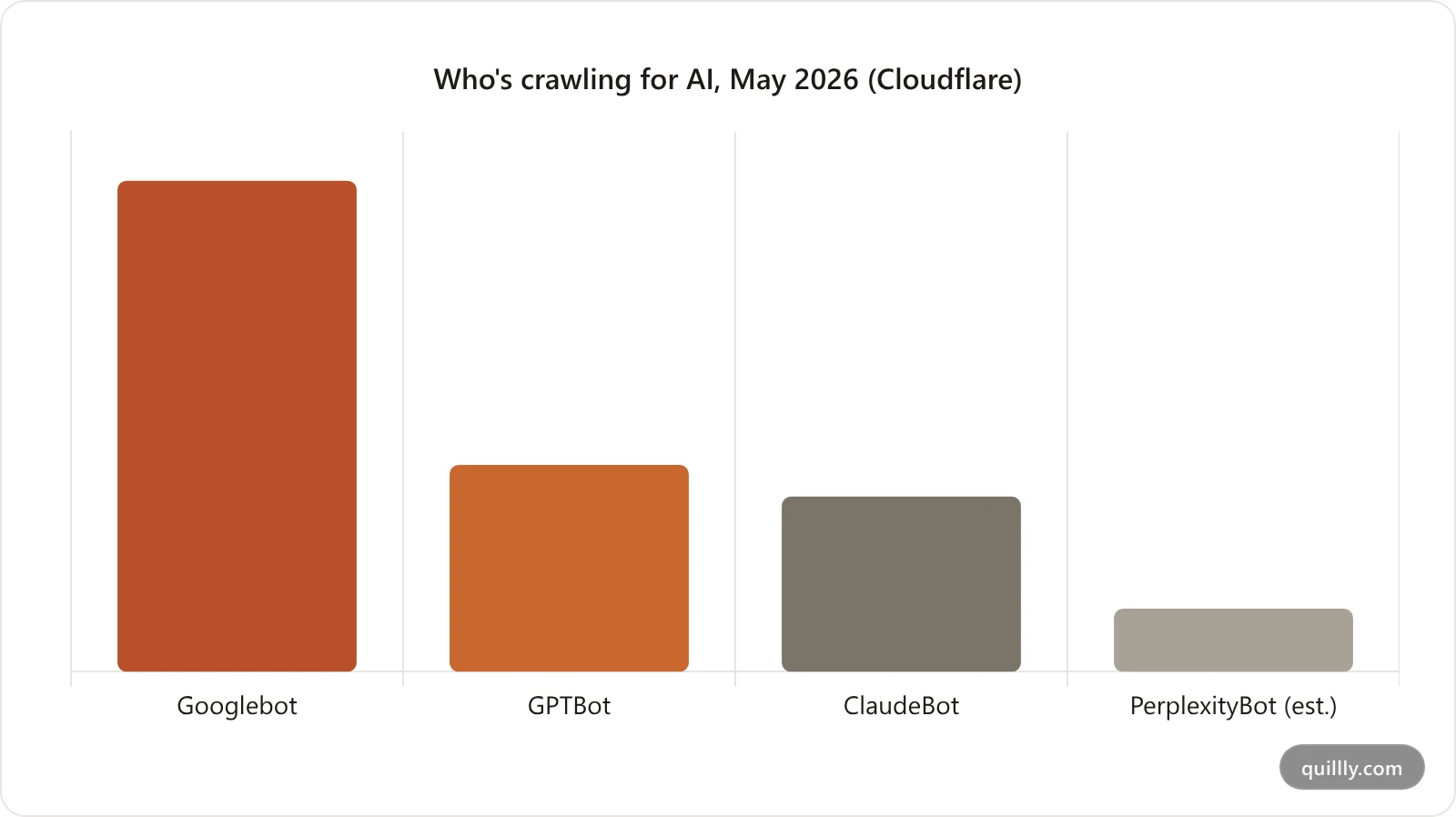
*AI crawler volume is real and growing: GPTBot alone rose 305% year over year*
## How to check if AI crawlers can read you
You can test your own pages in five minutes, no tools required. The fastest check is the JavaScript test: open your page, disable JavaScript, reload. If the body text vanishes, AI crawlers see the same emptiness.
For a truer picture, fetch the raw HTML the way a bot does and look for your actual content:
```bash
# See what a no-JS crawler receives
curl -sL https://yourdomain.com/blogs/your-post | grep -c "a distinctive sentence from your post"
# Check that your markdown twin exists and is clean
curl -sL https://yourdomain.com/blogs/your-post/llms.txt | head -40
```
If the first command returns `0`, your content isn't in the raw HTML. If the second returns clean markdown, your twin is live. Run this on your top 10 posts. The gap between "looks fine in a browser" and "empty to a bot" is where most citation opportunities quietly die. A blog that renders content server-side and ships a twin passes both checks at once.
## Frequently Asked Questions
### Do I need a markdown twin if my site is already server-side rendered?
It still helps. Server-side rendering solves the empty-div problem, so bots at least see your text. But a twin strips the nav, ads, and scripts that eat crawl budget and dilute signal, leaving pure content plus sources. SSR gets you in the door; the twin makes sure the most citable version of your page is the one machines read. Both together is the strongest setup.
### Is serving markdown to bots considered cloaking?
No, as long as it's the same content and the twin is served `noindex` with the HTML page kept canonical. Cloaking means showing bots different content than humans to manipulate rankings. A markdown twin is the identical article in a cleaner format, generated from one source so it can't diverge. You're adding a machine-readable surface, not deceiving the crawler or gaming search results.
### Should I use llms.txt or a markdown twin?
Use both, but lead with twins. Ahrefs found 97% of llms.txt files never get requested, so a root index alone reaches almost no one. Per-page markdown twins at dedicated URLs are what crawlers actually fetch. Publish an llms.txt index too, since it costs little and helps the rare agent that reads it, but don't expect it to do the heavy lifting on its own.
### Which AI crawlers should I care about?
The big ones are GPTBot and OAI-SearchBot (OpenAI), ClaudeBot (Anthropic), PerplexityBot (Perplexity), and Googlebot (Google). All except Googlebot generally skip JavaScript and read raw HTML, so your content must be present as plain text in the first response. Cloudflare data shows AI crawlers made up over 20% of verified bot traffic in 2026, with GPTBot up 305% year over year.
### Will a markdown twin slow down my site?
No. The twin is a separate lightweight URL that only bots and curious readers hit, so it never touches the performance of your main HTML page. It's typically generated from stored content and cached, so serving it costs almost nothing. If anything, it reduces load on the rendering path, because AI crawlers fetch the small markdown file instead of your full JavaScript app.
### How do I know it's working?
Check your server logs for hits on your `.md` or `/llms.txt` twin URLs from named AI crawlers, and watch for referral traffic from ChatGPT, Perplexity, and Google AI surfaces in analytics. On the content side, run the curl test above to confirm the twin returns clean markdown. Over weeks, track whether your pages start appearing as citations in AI answers for your target queries.
## The bottom line
AI crawlers are now a real slice of your audience, and most of them can't run your JavaScript or read your llms.txt file. Three numbers make the case: GPTBot's crawl volume grew 305% in a year, 97% of llms.txt files get zero requests, and brands cited in AI Overviews earn roughly 120% more clicks per impression. The move that connects those dots is a per-page markdown twin, advertised and discoverable, with your HTML page kept canonical.
Do it as a checklist: generate a twin per page, link it, keep the HTML canonical, and feed it to your sitemap. Test with the JavaScript trick and a quick curl. That's the whole method.
> **Ship the twin with every post, automatically**
> Your AI writes the article. Quillly generates the markdown twin, advertises it, keeps your HTML canonical, and adds it to your sitemap and RSS. No plumbing to maintain.
> → [Connect Quillly to Claude or ChatGPT](https://quillly.com)
Want your AI to actually publish the post it just wrote, twin and all? [Connect Quillly to Claude or ChatGPT in 30 seconds.](https://quillly.com){cta=signup}