---
title: Gemini SEO: How to Get Cited by Gemini in 2026
description: Gemini has 950M users and grounds answers in Google Search. Use the GROUND framework to get your site cited by Gemini in 2026, with data and a checklist.
keywords: Gemini SEO, how to get cited by Gemini, Gemini citations, Gemini grounding, generative engine optimization
published: 2026-07-25
updated: 2026-07-25
url: https://quillly.com/blogs/gemini-seo-get-cited
word_count: 3374
---
## Related Pages
- [019f2fbb-c87d-7273-86d9-22a17a238692](https://quillly.com/blogs019f2fbb-c87d-7273-86d9-22a17a238692)
- [019f0683-9b34-70c3-a758-926ffae22264](https://quillly.com/blogs019f0683-9b34-70c3-a758-926ffae22264)
- [019f7b3e-32b2-7237-b22f-63c685d54353](https://quillly.com/blogs019f7b3e-32b2-7237-b22f-63c685d54353)
- [019f20f9-9544-769b-bbda-8100447b1b6c](https://quillly.com/blogs019f20f9-9544-769b-bbda-8100447b1b6c)
- [019e1ec6-084f-71c0-98d8-99da870a7f27](https://quillly.com/blogs019e1ec6-084f-71c0-98d8-99da870a7f27)
- [019e80a2-e390-743b-b054-dc7c3934c173](https://quillly.com/blogs019e80a2-e390-743b-b054-dc7c3934c173)
*Photo by [Solen Feyissa](https://unsplash.com/@solenfeyissa?utm_source=quillly&utm_medium=referral) on [Unsplash](https://unsplash.com?utm_source=quillly&utm_medium=referral)*
Gemini crossed 950 million monthly users in mid-2026, up from 750 million in February, and its share of the AI-assistant market nearly tripled year over year. When that many people ask an AI instead of scrolling a results page, one question decides whether they ever see your site: does Gemini cite you? Gemini SEO is the practice of earning those citations, and it works differently from ranking a blue link. Gemini answers from its own model first and only "grounds" in Google Search when it decides the question needs fresh, verifiable facts. That gate changes everything about how you write.
Most guides still treat Gemini like a search engine with a chat skin. It isn't. As of July 2026, the sites that get cited share a specific shape: crawlable, fast, entity-rich, and broken into passages a model can lift without reading the whole page. This guide gives you the exact mechanism, a named framework called GROUND, and a copyable checklist you can run before you publish.
**Direct answer: To get cited by Gemini, publish crawlable pages that already rank in Google's top 10, structure every H2 around one verifiable, self-contained claim, back claims with specific numbers and named sources, and reinforce your entity with consistent off-site mentions. Gemini grounds in Google Search and extracts at the passage level, not the page level.**
## Why Gemini citations matter more in 2026
The takeaway: Gemini is now big enough that ignoring it leaves real traffic and brand mentions on the table. The standalone Gemini app reached roughly 950 million monthly active users in Q2 2026, and Google's AI Mode inside Search counts over a billion more. In the same window, [ChatGPT's market share slipped below 50% for the first time](https://techcrunch.com/2026/06/16/chatgpts-market-share-slips-below-50-for-first-time/) as Gemini surged. Optimizing only for ChatGPT in 2026 is like optimizing only for Bing in 2010.
Citations also compound differently than clicks. A Gemini answer that names your brand builds recognition even when the user never visits, and repeated mentions feed the entity signals that make future citations more likely. The catch: Gemini's citation slot is winner-take-few. A single answer usually pulls from three to five sources, so the bar is higher than page one of Google. If you'd rather your AI handle the whole publish-and-submit loop, [see how Quillly connects to your AI](https://quillly.com){cta=signup}.
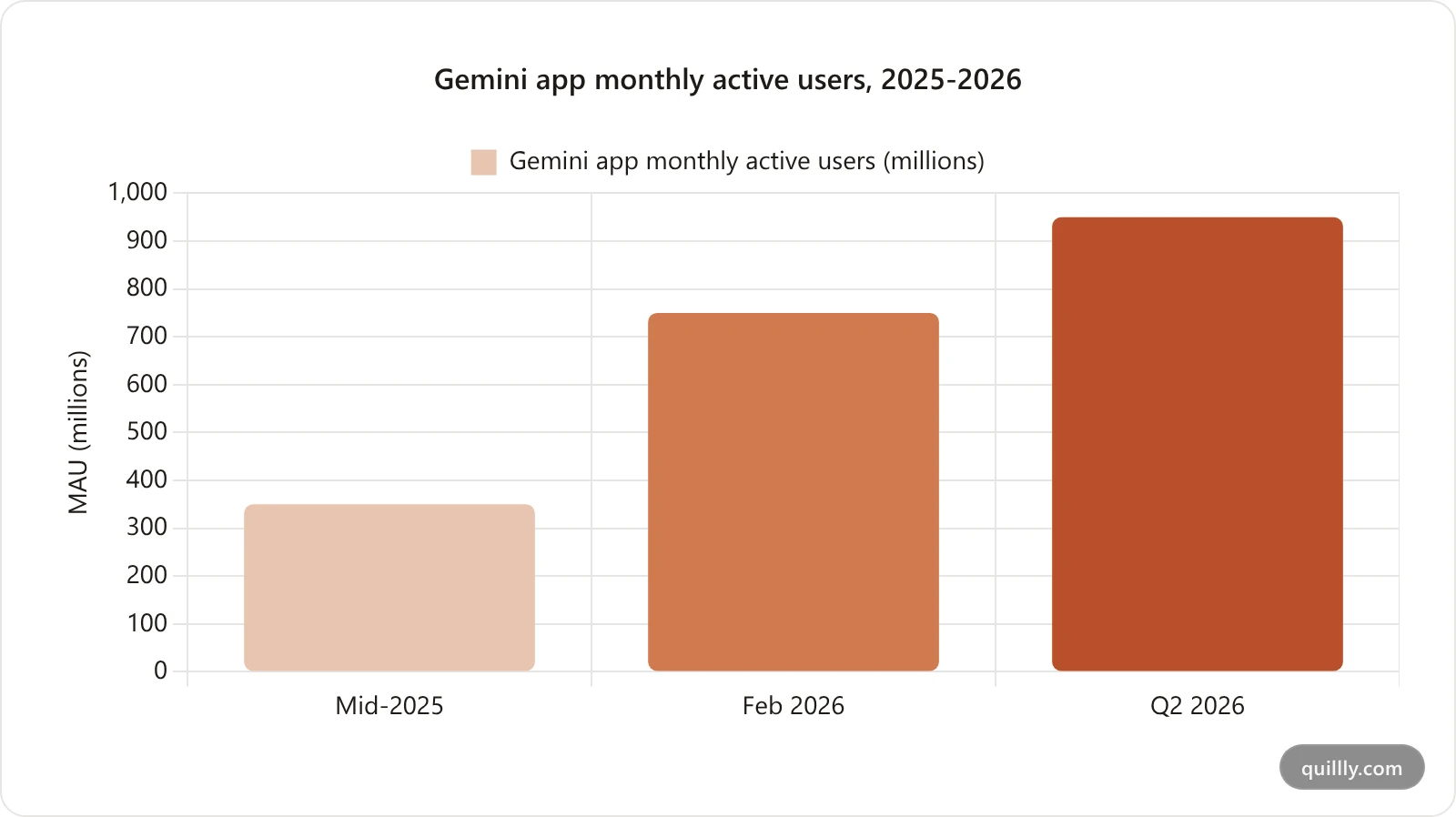
Gemini's user base tripled in a year, making its citations a channel you can no longer skip. (Source: SQ Magazine, FATJOE 2026.)
## How Gemini actually picks and cites sources
The takeaway: Gemini decides *whether* to search before it decides *what* to cite, and that first gate filters out most content. Gemini answers from its training corpus first and grounds on Google Search only when the model judges the question needs current or checkable facts, a behavior Google calls dynamic retrieval. If your topic never triggers grounding, no amount of on-page tuning gets you cited, so the play is to target the specific, factual queries that force a live search.
When grounding fires, the flow is retrieval-augmented: Gemini runs real Google Search queries, pulls candidate pages, and composes an answer from the passages it trusts. In the [Gemini API's grounding response](https://ai.google.dev/gemini-api/docs/google-search), sources come back as `groundingChunks` (each a URI and title) linked to `groundingSupports` that map exact answer text to the source that backs it. That mapping is passage-level: Gemini can cite one H2 block from a 3,000-word page and ignore the rest.
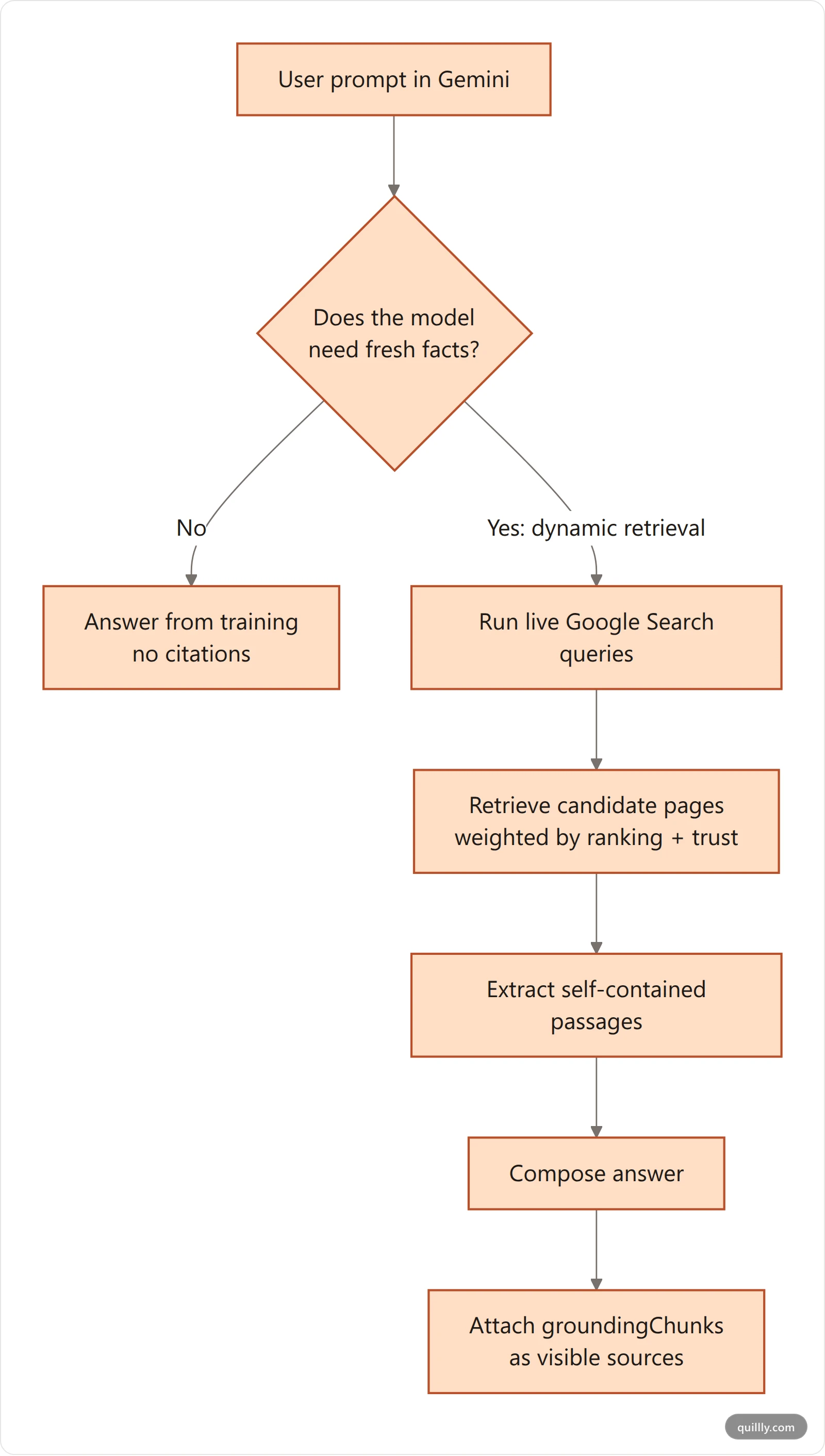
Gemini gates on retrieval first, then extracts citable passages, so both steps have to go your way.
On which pages it trusts, Gemini leans on the same signals Google Search uses: relevance to the prompt, E-E-A-T, and format fit for the query type. How-to prompts favor step content; research prompts favor data-heavy pages. [Google's own Gemini Apps help](https://support.google.com/gemini/answer/14143489) confirms a Sources button surfaces links inline or below the answer, though it isn't shown for every response.
## Gemini vs Google AI Mode: don't confuse the two
The takeaway: Gemini the assistant and AI Mode inside Google Search are different surfaces with overlapping but distinct optimization. AI Mode is the conversational tab inside Search that expands a query into many sub-queries (a technique called [query fan-out](/query-fan-out-ai-mode)) and stitches an answer from the results; we cover its mechanics in [our Google AI Mode SEO guide](/google-ai-mode-seo). The Gemini app is a standalone product spanning the mobile app, Gemini in Chrome, Workspace (Docs, Gmail, Sheets), and Deep Research.
The practical difference is intent and grounding. AI Mode almost always searches, so classic ranking matters most. The Gemini app searches selectively, so entity strength, and being memorable enough to surface from training, carries more weight. Deep Research, meanwhile, reads dozens of pages per task and rewards long, structured references over quick answers.
| Factor | Gemini app | Google AI Mode |
| --- | --- | --- |
| Where it lives | App, Chrome, Workspace, Deep Research | Search results tab |
| Grounds in Search | Selectively (dynamic retrieval) | Almost always |
| Biggest lever | Entity + authority signals | Organic ranking + query fan-out |
| Best content shape | Self-contained, citable passages | Comprehensive coverage of a topic |
| Citation surface | Sources button, inline links | AI Overview links |
Optimize for both, but tune your expectations to the surface. A page that ranks well helps everywhere; an entity that Gemini already "knows" wins the app-only, no-search answers your competitors never reach. [Start with a Gemini-ready draft in your AI](https://quillly.com){cta=signup}.
## The GROUND framework for Gemini citations
The takeaway: six moves, in order, take a page from invisible to citable. I call it GROUND because Gemini's whole citation system runs on grounding, and each letter maps to a lever you actually control. Run them top to bottom; the early ones gate the later ones.
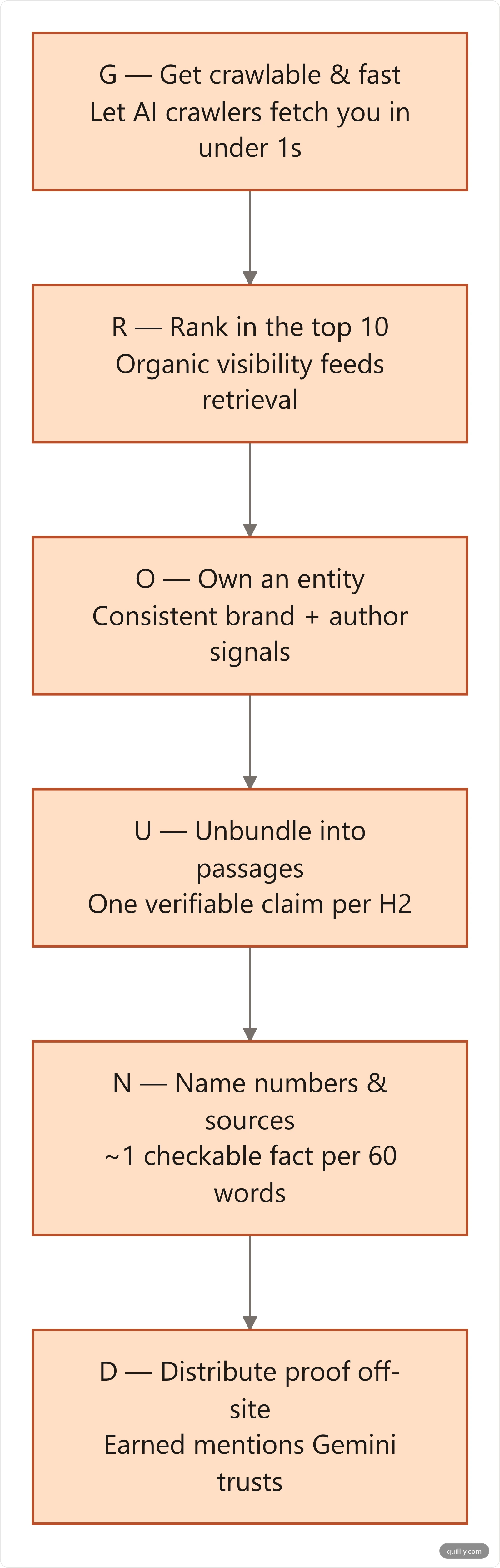
The GROUND framework: technical access and ranking come first, then structure and authority earn the citation.
Here is what each move means in practice:
- **G — Get crawlable and fast.** If a crawler can't fetch and parse the page, nothing downstream matters. Allow Google-Extended and the AI crawlers, ship clean server-rendered HTML, and keep load under a second.
- **R — Rank in the top 10.** Grounding pulls heavily from pages that already rank. Roughly 38% of citations on Google's AI surfaces come from the organic top 10, per a 2026 Ahrefs analysis, so page-one visibility remains your strongest retrieval signal.
- **O — Own an entity.** Gemini favors sources it recognizes. Consistent brand name, author bios, and `sameAs` links build the entity it can recall even without a search.
- **U — Unbundle into passages.** Because extraction is passage-level, every H2 needs one self-contained, quotable claim that reads correctly out of context.
- **N — Name numbers and sources.** Grounding supports specific, verifiable statements, roughly one named, checkable fact per 60 words. Vague prose gets skipped.
- **D — Distribute proof off-site.** Third-party mentions, reviews, and earned media tell Gemini your entity is trusted by others, not just by you.
The next sections drill into the moves that trip people up most: passages, entity, and technical access.
## Structure content for passage-level extraction
The takeaway: write each section so a single paragraph can be lifted and still make sense. Gemini rarely quotes a whole page; it grabs the one passage that answers the sub-question and drops it into the answer with a source link. If your key claim is spread across three paragraphs or leans on the sentence before it, the model can't cleanly extract it, so it moves to a competitor who made the job easy.
The pattern that wins is simple: lead every H2 and every list item with a declarative, self-contained sentence, then support it. Kevin Indig's research on 1.2 million ChatGPT citations found heavily cited text has an entity density around 20.6%, versus a 5-8% baseline for normal English, meaning cited passages name people, products, and numbers instead of gesturing at them.
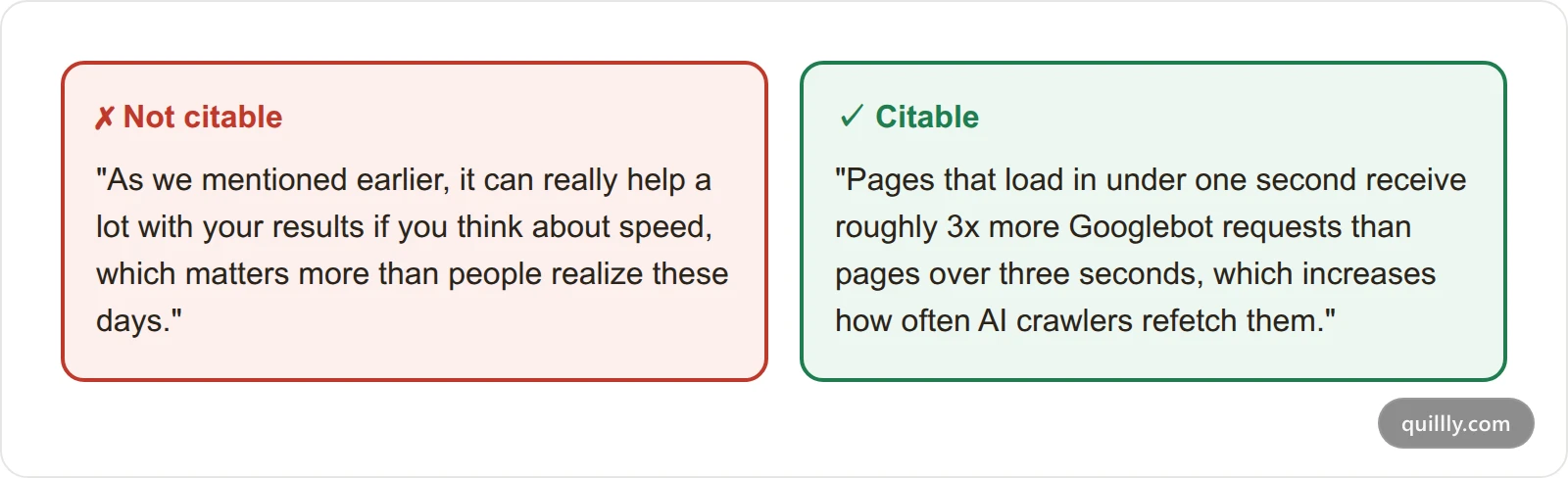
The citable version stands alone, names a number, and states cause and effect. That is what Gemini lifts.
Three habits make passages extractable: use question-shaped H2s that match how people prompt, answer in the first sentence below each heading, and keep one idea per paragraph. Tables help too, because a comparison row is already a self-contained unit. Our [complete guide to AI blog SEO](/complete-guide-ai-blog-seo) goes deeper on the on-page structure that carries across every AI surface.
## Build the entity and authority Gemini trusts
The takeaway: Gemini cites sources it recognizes as entities, so being *known* beats being merely *optimized*. An entity is a thing Google has in its Knowledge Graph, your brand, your authors, your product, with a stable identity across the web. When Gemini answers without searching, it can only surface entities it already learned. When it does search, entity strength breaks ties between similar pages.
> "GEO is a new layer on top of traditional SEO, but many of the fundamentals that drive visibility remain the same. Every major AI search product relies on live retrieval, which is dependent on positioning well within search engines. If your organic visibility dips, your AI search visibility will follow." — Kevin Indig, [Growth Memo](https://www.growth-memo.com/)
Build entity strength with three concrete moves. First, publish real author bios with credentials, a photo, and `sameAs` links to their profiles, so Gemini connects content to a verifiable person. Second, keep your brand name, description, and category identical across your site, LinkedIn, Crunchbase, and G2. Third, earn mentions on sites Gemini already trusts, because third-party endorsement is the strongest authority signal an LLM can read. SEO educator Aleyda Solis frames the pre-work bluntly: before you optimize a sentence for citation, the bots that feed the LLM have to fetch and parse your pages, which is why [crawlability comes first](https://www.learningseo.io/). If you're starting from a cold domain, our [guide to increasing Domain Rating](/increase-domain-rating-2026) covers the off-site groundwork.
## Nail the technical retrievability layer
The takeaway: AI crawlers can only cite what they can fetch, render, and refetch quickly. Gemini's grounding relies on Google's index, and Google's AI features also use the Google-Extended crawler token. Block it and you may keep ranking in classic Search while quietly disappearing from AI answers, so check your `robots.txt` first.
Four technical fixes move the needle most. Serve content in the initial HTML rather than client-only JavaScript, since crawlers extract far more reliably from server-rendered markup. Add structured data, Article, FAQPage, and HowTo schema, so machines parse your entities and Q&A blocks without guessing. Keep response times under 200ms and full loads under a second; fast pages get crawled more often. And publish a clean sitemap plus an `llms.txt` so AI systems can find your best pages. Our [AI crawler optimization guide](/ai-crawler-optimization-2026) lists every crawler token and how to handle each.
| Technical signal | Target | Why Gemini cares |
| --- | --- | --- |
| Google-Extended access | Allowed in robots.txt | Feeds Google's AI grounding |
| Render mode | Server-rendered HTML | Reliable passage extraction |
| Page load | Under 1 second | 3x more crawl requests |
| Structured data | Article + FAQ + HowTo | Machine-readable entities |
| Freshness | Updated + resubmitted | Grounding favors current facts |
Speed and access are unglamorous, but they are the gate. A brilliant, quotable page that renders only in JavaScript or loads in four seconds will lose to a plainer page a crawler can read instantly. [Fix the crawl layer first](/complete-guide-ai-blog-seo), then earn the citation.
## Publish and measure Gemini citations with MCP
The takeaway: you can write, score, and ship a Gemini-ready page from the same AI chat you already use, then watch whether it gets pulled. This is where Quillly fits: your AI writes the draft, and Quillly handles the SEO scoring, publishing to your own domain, and search-engine submission that grounding depends on. The workflow is a short sequence of MCP tool calls.
```text
# From Claude, ChatGPT, or Cursor via the Quillly MCP server
create_content → save the draft on your domain
check_blog_seo → score it against 14 criteria, fix gaps
publish_content → go live + auto-submit sitemap to Google & Bing
```
After `publish_content` runs, Quillly submits your updated sitemap and pings IndexNow so Google and Bing discover the page fast, which is the precondition for Gemini grounding to ever retrieve it. Because Quillly renders charts and diagrams server-side as static images, the visuals in this very post are crawlable, not locked inside JavaScript. To confirm you're getting pulled, prompt Gemini with the exact questions your page answers and click the Sources button, then [track branded and unbranded AI referral traffic](/track-ai-search-traffic) over time.
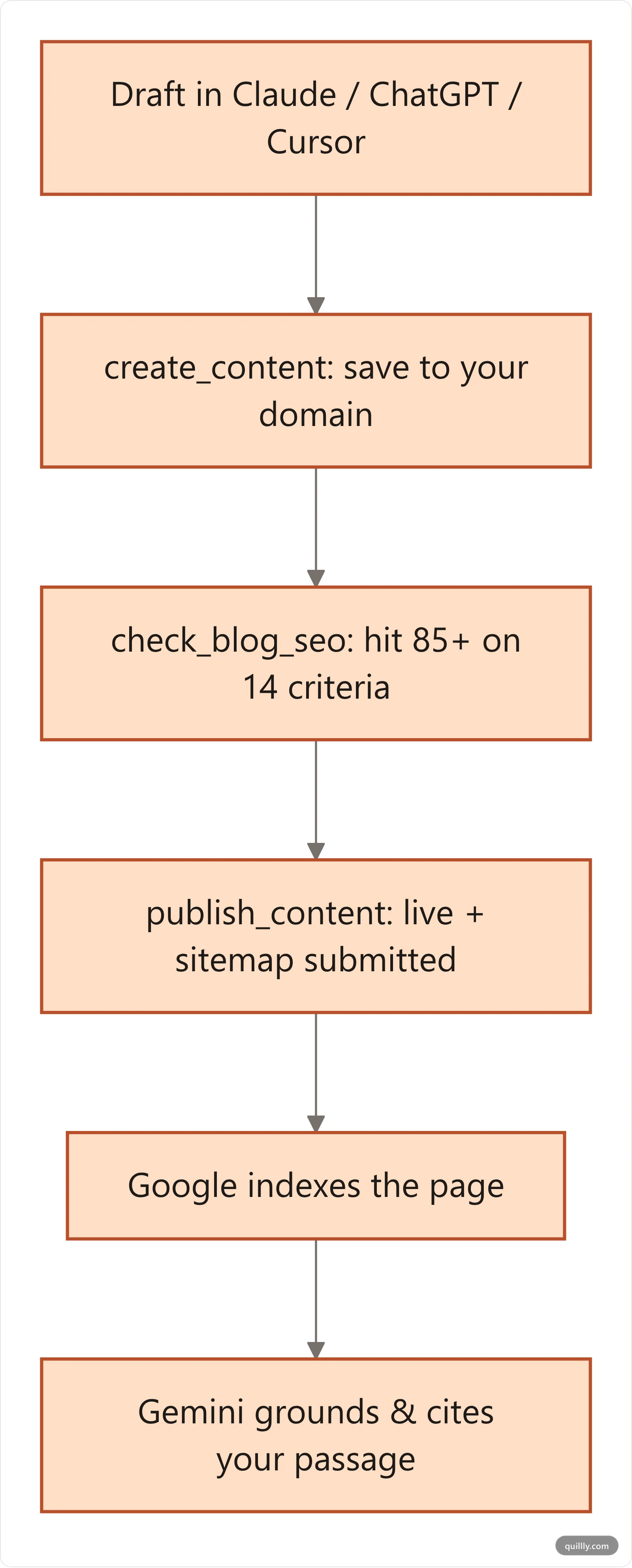
Your AI writes; Quillly handles the publishing and submission that get the page into Gemini's reach. [Publish your first Gemini-ready post free](https://quillly.com){cta=signup}.
## Your Gemini citation checklist
The takeaway: run this list before you publish and you'll clear the bar for most groundable queries. Each item maps to a letter of the GROUND framework, so a miss tells you exactly which lever to fix.
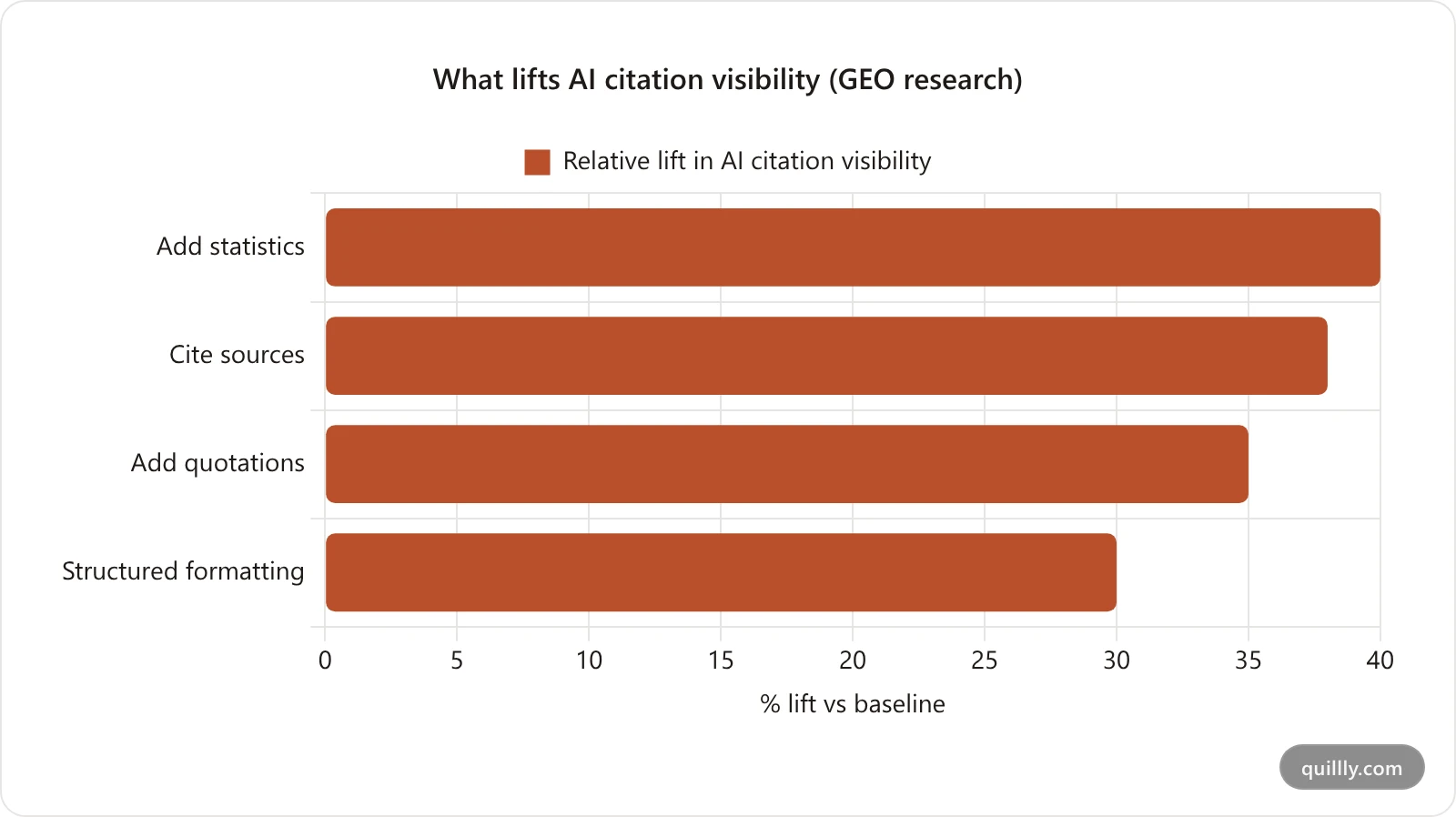
Numbers, sources, and quotes, the N in GROUND, are the highest-leverage edits for Gemini citations. (Source: Princeton GEO study.)
| ✓ | Check | GROUND move |
| --- | --- | --- |
| ☐ | Google-Extended and AI crawlers allowed in robots.txt | G |
| ☐ | Page loads in under 1 second, server-rendered HTML | G |
| ☐ | Target query already ranks (or can rank) in the top 10 | R |
| ☐ | Author bio with credentials and sameAs links | O |
| ☐ | Brand name and category consistent across the web | O |
| ☐ | Every H2 leads with one self-contained, quotable claim | U |
| ☐ | Question-shaped H2s that match real prompts | U |
| ☐ | ~1 verifiable stat or named source per 60 words | N |
| ☐ | Article + FAQ + HowTo structured data present | N |
| ☐ | At least one earned third-party mention of the entity | D |
Copy it into your content brief and treat any unchecked box as a reason not to publish yet. Most pages that miss Gemini citations fail on U and N, great information trapped in vague, source-free prose.
## Frequently asked questions
### Does Gemini actually cite sources?
Yes, but not on every answer. Gemini shows a Sources button with links inline or below the response when it grounds a query in Google Search, according to Google's Gemini Apps help. For answers it generates from training alone, no sources appear. That's why targeting specific, factual queries, which trigger grounding, is the reliable path to earning visible Gemini citations.
### How is Gemini SEO different from regular SEO?
Regular SEO earns a ranked link a user clicks. Gemini SEO earns a cited passage inside an AI answer, often with no click at all. Rankings still matter because grounding pulls from search results, but Gemini adds two demands classic SEO ignores: passage-level self-containment and strong entity signals so the model recognizes and trusts your source.
### Do I need to rank on page one to get cited by Gemini?
It helps a lot but isn't strictly required. A 2026 Ahrefs analysis found about 38% of citations on Google's AI surfaces come from the organic top 10, while a large share come from further down or off the SERP entirely. Ranking well is the strongest single retrieval signal, but entity authority and citable structure can pull in pages that rank lower.
### How do I check if Gemini is citing my site?
Prompt Gemini with the exact questions your content answers, then open the Sources button to see which URLs it used. Repeat across several phrasings, because grounding varies by query. For scale, track AI referral traffic in your analytics and watch for branded mentions, and use rank and citation monitoring to spot changes over time.
### Should I block Google-Extended to protect my content?
Only if you're willing to lose AI visibility. Google-Extended controls whether your content feeds Google's generative AI features, including the grounding behind Gemini answers. Blocking it can remove you from AI citations while leaving classic Search intact, a trade most publishers chasing AI traffic don't want to make.
### How long is the ideal page for Gemini citations?
There's no fixed length, but depth wins. GEO studies show that statistics, quotes, and structured formats in longer, well-organized content raise citation rates meaningfully. What matters more than word count is that each section stands alone as a quotable, sourced passage, so a 2,000-word page of dense, citable blocks beats a 4,000-word page of filler.
## Conclusion
Gemini's near-billion users and selective grounding make it the AI surface you can't afford to skip in 2026, and the path to citation is more concrete than it looks. Three things carry most of the result: rank in the top 10 so grounding can retrieve you (roughly 38% of AI citations come from there), structure every H2 as one self-contained, source-backed claim, and reinforce your entity with consistent off-site proof. Run the GROUND framework and the checklist above before you publish, and treat any missed lever as your next task.
The fastest way to close the loop is to stop copy-pasting between your AI and your CMS. Want your AI to actually publish the post it just wrote, scored and submitted to search?
> **Get cited by Gemini, straight from your AI**
> Connect Quillly to Claude, ChatGPT, or Cursor and go from prompt to a published, SEO-scored page on your own domain in 30 seconds. Your AI writes. Quillly handles the ranking.
> → [Connect Quillly in 30 seconds](https://quillly.com)