---
title: Do AI Content Detectors Work? The 2026 Accuracy Data
description: AI content detectors miss humanized text and flag real writers. See the 2026 accuracy data, why Google ignores them, and what to measure instead.
keywords: AI content detector accuracy, do AI content detectors work, AI detector false positives, does Google use AI detectors, humanized AI content
published: 2026-07-21
updated: 2026-07-21
url: https://quillly.com/blogs/ai-content-detector-accuracy
word_count: 2789
---
## Related Pages
- [019eaef8-4dbf-71ab-85a9-f1210153ddca](https://quillly.com/blogs019eaef8-4dbf-71ab-85a9-f1210153ddca)
- [019e7b82-4c29-779f-a2dd-d2fabdc9bcf4](https://quillly.com/blogs019e7b82-4c29-779f-a2dd-d2fabdc9bcf4)
- [019e0507-5c34-700c-8ff6-ffa9b9c660f6](https://quillly.com/blogs019e0507-5c34-700c-8ff6-ffa9b9c660f6)
- [019e42d9-7628-74ab-a73d-c3b2e2f6558a](https://quillly.com/blogs019e42d9-7628-74ab-a73d-c3b2e2f6558a)
- [019ea4af-3849-73af-880a-6ae048a71cbc](https://quillly.com/blogs019ea4af-3849-73af-880a-6ae048a71cbc)
You wrote a solid post with an AI assistant, pasted it into an AI content detector, and it flashed back "87% AI-generated." Now you're bracing for Google to bury the page, or nuke your whole site. Breathe. That score tells you almost nothing useful. In July 2023, OpenAI quietly shut down its *own* AI content detector because it correctly flagged just 26% of AI-written text while wrongly accusing 9% of human writing ([TechCrunch](https://techcrunch.com/2023/07/25/openai-scuttles-ai-written-text-detector-over-low-rate-of-accuracy/)). If the company that builds the models can't reliably spot their output, the $12-a-month tool promising "99.8% accuracy" deserves hard scrutiny.
This guide breaks down what AI content detectors actually measure, how accurate they really are as of July 2026, why they flag legitimate human writers, and the part most articles skip: whether any of it touches your search rankings. The honest version isn't the one the detector companies sell you.
**Short answer:** AI content detectors don't reliably work. They estimate probability from writing patterns, not proof of origin, so they miss humanized AI text almost entirely and falsely flag genuine human writing, especially from non-native English speakers. Google doesn't use them to rank pages. Optimize for helpfulness, not for a detector score.
## How AI content detectors actually work
An AI content detector never "knows" who wrote your text. It guesses, using two statistical tells. **Perplexity** measures how predictable each word is: large language models tend to pick the most probable next word, so their output has low perplexity, while humans write with more surprise. **Burstiness** measures variation in sentence length and structure: humans mix long and short sentences unevenly, models trend uniform. The detector runs your text through a classifier trained on these patterns and returns a probability, then a marketing team rounds that into a confident-looking "92% AI."
That design has a fatal gap: predictable, uniform, clean writing looks "AI" whether a machine or a careful human produced it. The tool measures a *style*, not an *origin*. Once you understand that, every weird result below stops being surprising.
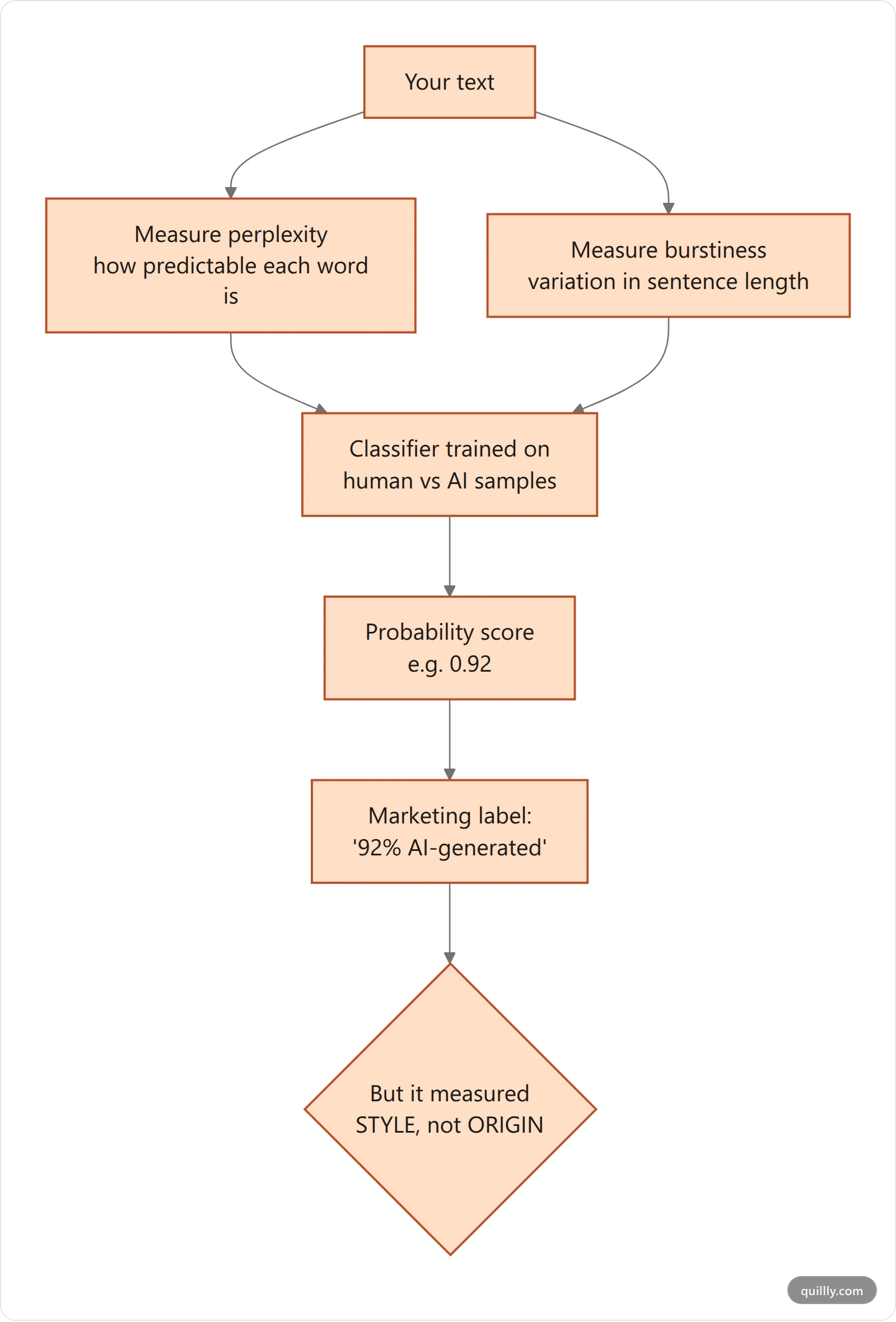
*How an AI content detector turns your writing into a probability score, and where the logic breaks.*
## AI content detector accuracy: what the 2026 data shows
Detector accuracy is real but narrow: it holds up on raw, unedited AI text and collapses everywhere else. On untouched model output, the strongest tools score well. In third-party testing, Turnitin caught around 96% of raw AI text, Originality.ai roughly 94%, and GPTZero about 92% ([Originality.ai meta-analysis](https://originality.ai/blog/ai-detection-studies-round-up)). Those are the numbers vendors put on the homepage.
The floor drops the moment text is edited. On lightly paraphrased AI writing, detection falls to the 41–72% range depending on the tool. And nobody publishes raw model output anyway, so the homepage number describes a scenario that barely exists in real content workflows.
| Text type | Best detector accuracy | Reality for publishers |
| --- | --- | --- |
| Raw, unedited AI output | 92–96% | Almost nobody ships this |
| Lightly paraphrased AI | 41–72% | Common after one editing pass |
| Human writing (clean, structured) | flagged 5–20%+ falsely | The false-positive trap |
| Humanized via NLP tool | ~0% detected | The loophole that breaks everything |
The takeaway is uncomfortable for the detection industry: the more a human touches AI-assisted text, which is exactly what good editing is, the less any detector can tell. Accuracy isn't a fixed property of the tool. It's a property of how edited your content is, and real content is heavily edited.
## The false-positive problem: real writers get flagged
Here's the number that should end the debate for anyone using detectors as proof: they routinely accuse innocent humans. A widely cited Stanford study found detectors falsely flagged 61.3% of TOEFL essays written by non-native English speakers as AI-generated, because non-native writing tends toward simpler, more predictable phrasing, the exact signal detectors punish. Native-speaker essays from the same pool were flagged far less. The tool isn't detecting AI. It's detecting a writing style, and penalizing people for it.
It gets worse under light editing. University of Maryland researchers showed that minimally polishing human or AI text with GPT-4o pushed detection rates anywhere from 10% to 75% depending on the tool, meaning a single "make this clearer" pass can flip a verdict. A 2026 analysis also found detector accuracy on scientific texts ran 28–38 percentage points *lower* than on humanities texts. Same tool, wildly different reliability based on subject matter alone.
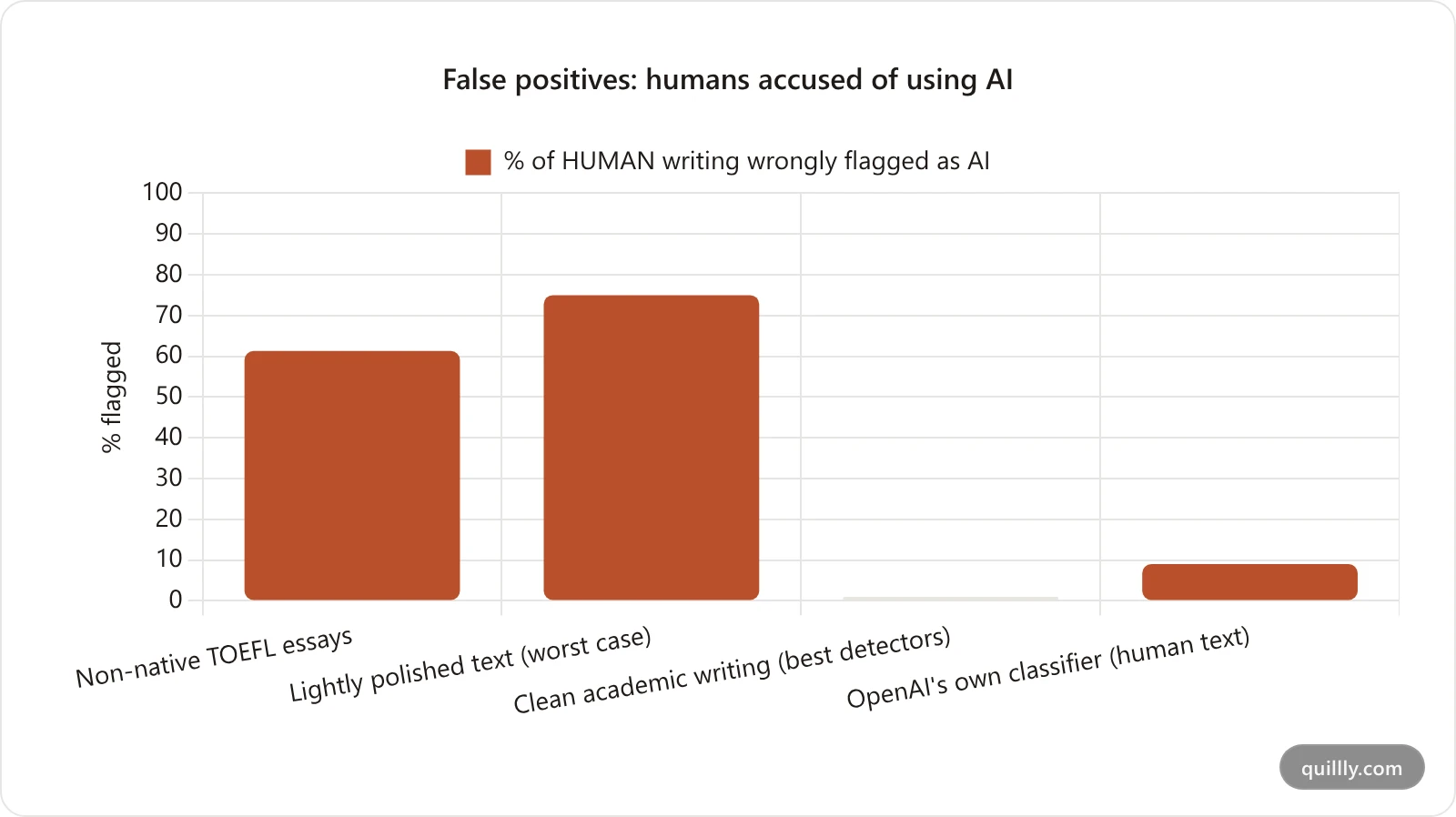
*False-positive rates vary wildly, but even the best case means real writers get accused. Non-native English speakers pay the highest price.*
For a founder or small team, a false positive isn't academic. It's you rewriting a perfectly good page three times, chasing a green score that was never measuring quality in the first place. If you want to know what genuinely moves rankings for machine-assisted content, our breakdown of [what actually ranks in AI autoblogging](/ai-autoblogging-2026) is a better use of that hour.
## The humanizer loophole that breaks every detector
If detectors worked, humanizer tools couldn't exist. They do, and they win. When researchers ran AI text through a purpose-built NLP humanizer, every single detector returned a 0% AI reading ([Walter Writes analysis](https://walterwrites.ai/are-ai-detectors-accurate/)). Not "lower." Zero. The arms race is already over, and the detectors lost.
Think through what that means as a system. Raw AI text might get flagged at 94%. Push it through a $10 humanizer and the same content reads as 0% AI. The words carry the same information, the same value or lack of it, but the verdict inverts completely. A signal that a cheap wrapper can flip to any value you want is not a signal. It's theater.
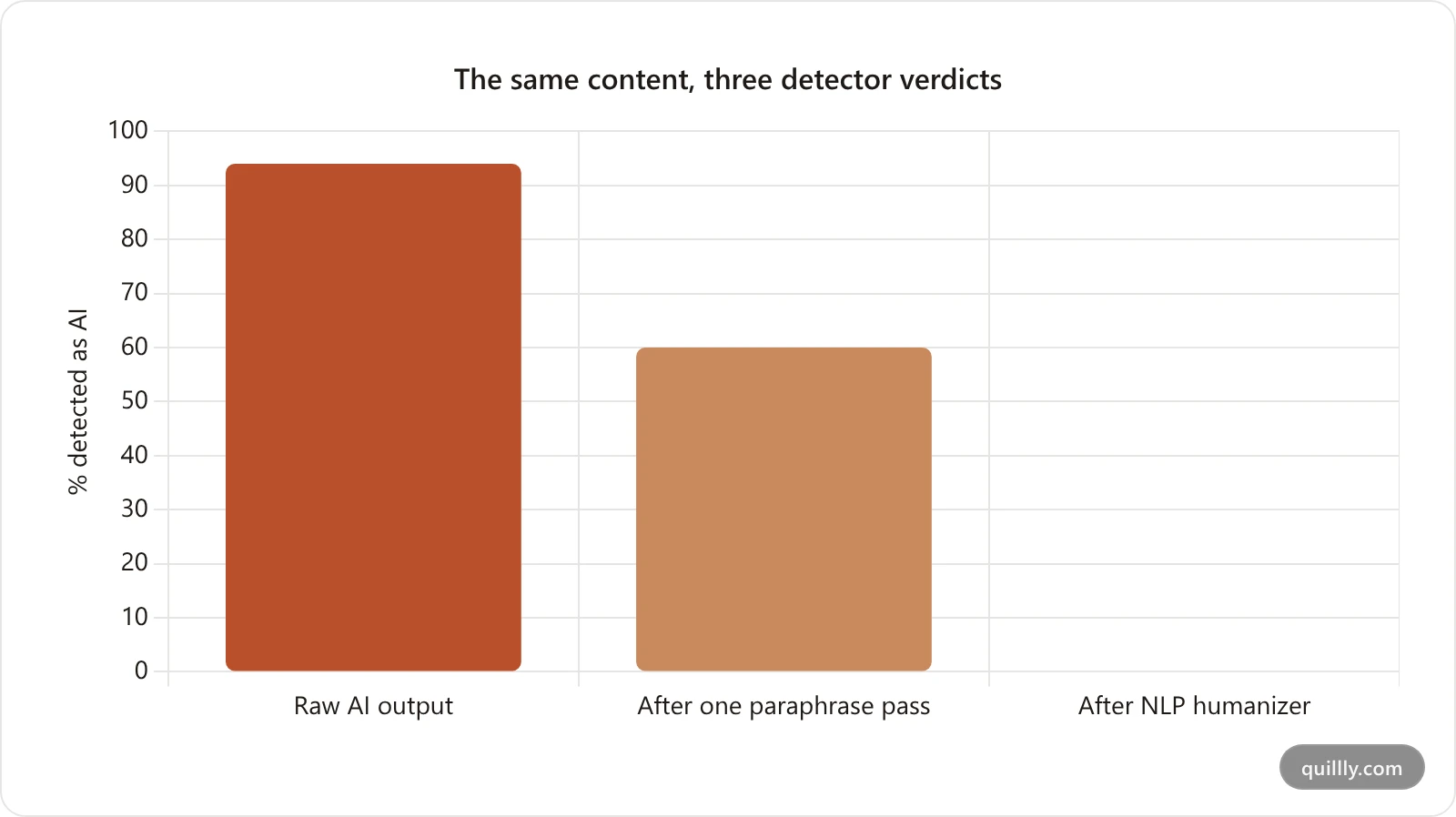
*Identical information, three different verdicts. The detector measures how much the text was processed, not whether it deserves to rank.*
The practical lesson isn't "go buy a humanizer." It's that a metric this easy to game can't be the metric Google, or you, should care about. [Let your AI publish to a real quality bar instead.](https://quillly.com){cta=signup}
## Does Google use AI content detectors? No, and here's why that matters
The fear driving detector anxiety is that Google runs your page through something like Originality.ai and demotes anything that scores "AI." It doesn't. Google's own guidance is blunt: appropriate use of AI is not against its rules, and the search team evaluates content on quality and helpfulness regardless of how it's produced. Search Advocate John Mueller has said repeatedly that Google doesn't care *who or what* writes your content, only whether it's helpful, accurate, and made for people.
Google *does* act on **scaled content abuse**, mass-producing pages to game rankings with little added value. But that policy triggers on the behavior, not the tool. As Search Engine Land summarized Google's position, normal SEO is what works for AI-era visibility, and the algorithm targets low-value content rather than AI itself ([Search Engine Land](https://searchengineland.com/google-says-normal-seo-works-for-ranking-in-ai-overviews-and-llms-txt-wont-be-used-459422)). We unpack the enforcement details in [does Google penalize AI content](/does-google-penalize-ai-content) — the short version is that a detector score and a ranking risk are two unrelated things.
The evidence backs the policy. A 2025 Ahrefs study of roughly 600,000 pages found 86.5% of top-ranking pages contained some AI assistance, and the correlation between AI-content percentage and ranking position was 0.011, statistically indistinguishable from zero. Pages don't rank or sink because of how "AI" they read. They rank on whether they answer the query better than the alternatives. [Grade your draft on what Google actually rewards.](https://quillly.com){cta=signup}
> "There's nothing new or special about AI-generated content that we need to have policies specifically for. What matters is the quality of the content, not how it's produced." — Google Search Central guidance, echoed by John Mueller
## Why chasing detector scores is the wrong SEO move
Optimizing for a detector is optimizing for the wrong scoreboard. Every hour spent rewording a sentence to drop a perplexity flag is an hour not spent adding an original stat, a screenshot, a first-hand result, or a clearer answer, the things that actually earn rankings and AI citations. Worse, "beating the detector" often means adding deliberate messiness and filler, which makes content *less* helpful. You can degrade a good page trying to make it look more human to a bot.
There's also a strategic cost. Detector scores went from industry obsession to near-irrelevance in about two years, with SEO teams openly abandoning them for quality-first workflows ([Stan Ventures](https://www.stanventures.com/news/why-ai-content-checker-tools-are-losing-relevance-in-2025-from-detection-to-real-value-4503/)). Building your process around a metric the market is walking away from is technical debt. The teams winning in 2026 treat "will this get cited by ChatGPT and rank in Google" as the only question that pays rent.
If your AI content isn't performing, the cause is almost never that it "looks AI." It's thin coverage, no original angle, weak internal links, or indexing problems, the real culprits we walk through in [why your AI blog isn't ranking](/ai-blog-not-ranking-2026).
## The Helpfulness-First Workflow: what to measure instead
Stop scoring for detection. Score for the things Google and AI answer engines actually reward. Here's a repeatable method you can run on every post, the **Helpfulness-First Workflow**:
1. **Original signal.** Does the page contain at least one thing that exists nowhere else, your own data, a tested result, a screenshot, a customer number, a specific example? This is the single biggest driver of AI citations.
2. **Experience markers.** Does it show first-hand use, "we ran this on 125 posts," not "studies show"? This is the first E in [E-E-A-T for AI content](/eeat-for-ai-content-2026), and it's what detectors can never fake for you.
3. **Answer-first structure.** Does each section lead with the takeaway in sentence one, so an AI Overview can lift it cleanly?
4. **Verifiable claims.** Is every stat linked to a real source? Pages with 5+ sourced stats get cited noticeably more by ChatGPT.
5. **Quality score, not AI score.** Run the finished page through a real SEO scorer and fix what it flags.
That last step is where a scoring engine earns its keep. Instead of pasting your draft into a detector, run `check_blog_seo` — it grades the page against 14 criteria like depth, structure, internal links, and readability, then `get_blog_seo_patches` hands you the exact fixes. You're measuring what ranks, not whether a classifier thinks a robot helped. [Connect your AI and auto-score every post.](https://quillly.com){cta=signup}
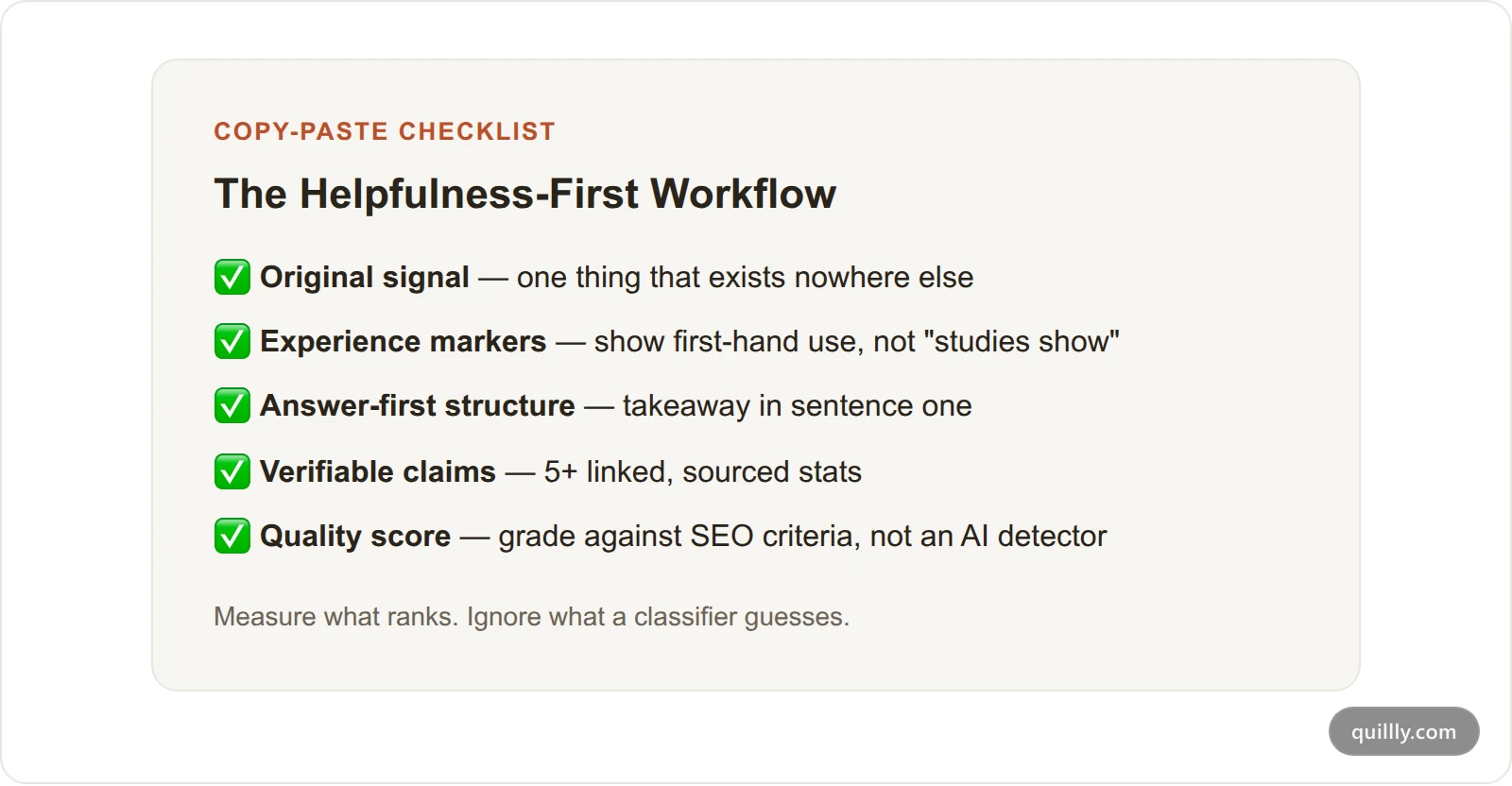
*The Helpfulness-First Workflow: five checks that predict rankings and AI citations far better than any detector score.*
## When an AI detector is actually useful (and when it isn't)
Detectors aren't useless in every context, they're just misapplied for SEO. As one *soft* signal among many, a teacher or editor might use a high score as a prompt to look closer, never as a verdict. Even there, most academic-integrity bodies now advise treating detector output as a single data point, not proof, precisely because of the false-positive problem ([Springer, International Journal for Educational Integrity](https://link.springer.com/article/10.1007/s40979-026-00213-1)).
For a publisher trying to rank, the honest use cases are narrow: spot-checking whether a freelancer shipped you raw, unedited model output (a quality-control tell, not a compliance one), or gut-checking that a page reads naturally. That's it. The moment you treat the score as "Google will punish this," you've left the evidence behind. Where you'd genuinely never want AI touching publishing unsupervised, the real safeguards are review and quality gates, which we cover in [is it safe to let AI publish to your site](/safe-ai-blog-publishing) — not a detector.
## Frequently Asked Questions
### Can Google detect AI content?
Google has systems that can recognize patterns associated with AI text, but it does not run a pass/fail AI detector that demotes pages for being machine-written. Its guidance states that appropriate AI use is allowed and content is judged on quality and helpfulness, not origin. The practical answer: even if Google can guess, it doesn't rank on that guess.
### Do AI content detectors actually work?
They work only in a narrow case: raw, unedited AI text, where top tools hit 92–96%. On paraphrased, edited, or humanized content, accuracy collapses, dropping to 0% against purpose-built humanizers. They also falsely flag human writing, so they can't reliably prove origin either way. For real published content, which is edited, they're unreliable.
### Will AI-assisted content hurt my SEO?
Not because it's AI-assisted. A 2025 Ahrefs study found 86.5% of top-ranking pages used some AI, with near-zero correlation between "AI-ness" and rank. Content gets hurt when it's thin, unoriginal, or mass-produced to game rankings, the scaled-content-abuse problem, regardless of whether a human or a model drafted it.
### Why do AI detectors flag human writing as AI?
Because they measure style, not origin. Clean, predictable, uniformly structured writing produces the same low-perplexity signal a model does. Non-native English speakers get hit hardest, a Stanford study found 61.3% of TOEFL essays wrongly flagged. Technical and scientific writing also trips detectors more often than casual prose.
### Are paid AI detectors more accurate than free ones?
Paid tools generally have lower false-positive rates and better raw-text detection than free ones, but they share the same core weakness: they fail on edited and humanized text, and they still flag some human writing. Paying more buys marginally better performance on a task that doesn't predict search rankings, so it rarely changes the decision that matters.
### Should I use a humanizer to pass AI detection?
Only if a specific gatekeeper forces the issue, and even then, understand you're gaming a metric, not improving the page. Humanizers can strip clarity and inject filler, making content worse for readers. For SEO there's no upside: Google doesn't score detection, so a humanizer solves a problem you don't have while risking real quality.
### What's the most accurate AI content detector?
In third-party tests, Turnitin, Originality.ai, and GPTZero lead on raw AI text (roughly 92–96%). But "most accurate" is misleading, since every leader still fails on edited and humanized content and produces false positives. The most accurate tool for predicting rankings isn't a detector at all, it's a quality scorer that grades helpfulness.
## The bottom line on AI content detectors
Three things to take away. **One:** AI content detectors are unreliable by design, strong on raw AI text (92–96%) but dropping to 0% on humanized content while falsely flagging up to 61.3% of non-native human writing. **Two:** Google doesn't use them, and with 86.5% of top-ranking pages already AI-assisted and a 0.011 correlation to rank, the detector score has no bearing on your visibility. **Three:** the metric that does predict rankings is helpfulness, run the five-step Helpfulness-First Workflow and grade against real SEO criteria, not a classifier's guess.
The detector-anxiety era is ending. The builders pulling ahead stopped asking "does this look AI?" and started asking "is this the best answer on the internet for this query?" That's the only score that pays.
Want your AI to write *and* rank, without the detector theater? [Connect Quillly to Claude or ChatGPT in 30 seconds](https://quillly.com){cta=signup} and let it publish content scored on what Google actually rewards.